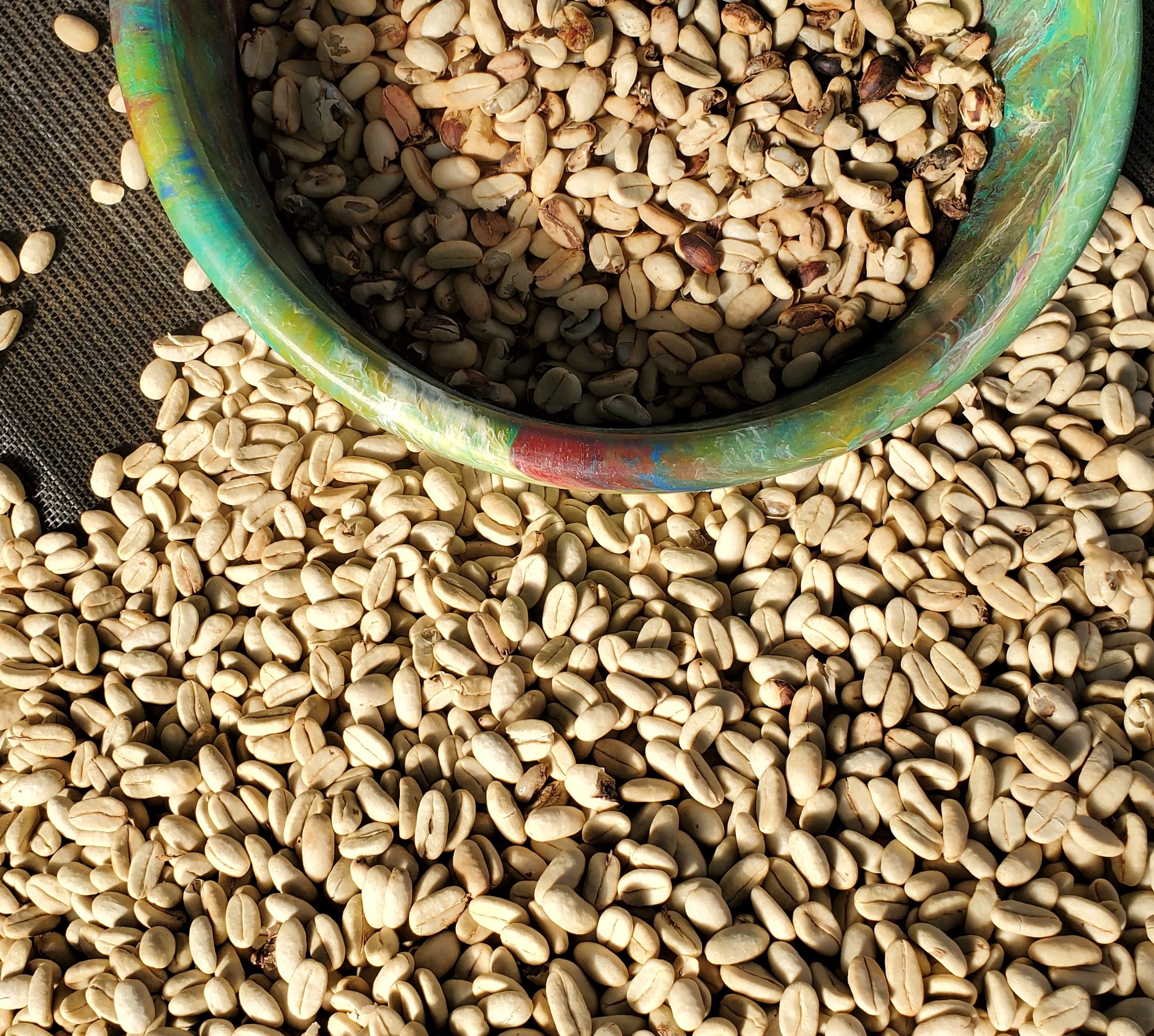
Density sits on the spec sheet between moisture and screen size, often noted, rarely interrogated. That is a mistake.
Density tells you how a green bean was grown. How slowly. At what elevation. Whether it was picked at peak maturity or not. How it was processed. How much moisture it carries. And, critically, how it will behave inside a roaster.
It is not a quality score. No single number is. But it is one of the most reliable behavioural predictors in the supply chain.
Density is mass divided by volume. For green coffee, we express it in grams per millilitre (g/mL) or, in laboratory and commercial settings, grams per litre (g/L). These are interchangeable units — 680 g/L equals 0.68 g/mL.
It measures how much coffee mass occupies a given space. A denser bean has a more compact cellular structure, tighter cell walls, fewer internal air pockets. A less dense bean is more porous and open.
The ISO standard for measuring bulk (freely settled) density of whole green coffee is ISO 6669:1995. This is the method most commonly used by importers and QC labs — and the one we use at change of tone. on every lot we contract.
Density is not fixed. It is earned. Several interacting factors determine how dense a green coffee bean will be:
At higher elevations, temperatures drop at night. Cherries ripen more slowly. That extended maturation period means more cellular development inside the seed — more sugars, more complex acids, more compact structure. A coffee grown at 1,800 masl will, all else equal, be denser than the same variety grown at 1,000 masl.
This is why producers like Jhon Alvarado Abarca at Corazón de Jesús (Chirripó, Costa Rica — 1,800–1,950 masl) and the Familia Salazar at Los Cipreses (Naranjo, Costa Rica — 1,600–1,650 masl) consistently produce coffees on the higher end of the density range. Altitude compresses the bean. Slowly. Over months.
Genetic architecture matters. SL28, Gesha, and Parainema varieties tend toward higher density at equivalent altitudes than, say, some Catuai or Robusta-derived cultivars. Cultivar influences both cell wall thickness and the density of sugars and acids stored within.
Processing has a measurable impact. Washed coffees — with the mucilage fully removed before drying — tend to be 3–5% denser than equivalent naturals. Why? The absence of surrounding fruit material means the bean dries more uniformly. Less residual sugar coating also means less surface disruption during drying.
Naturals and honeys carry more of that fruit layer into drying. The result is often a slightly more porous bean structure. Not inferior — different. But relevant for roasting.
Rene Fernandez — Las Huellas, Santa Barbara, Honduras Rene's Parainema lots at 1,670–1,760 masl routinely test at the middle-high range for their altitude. The drying facility we co-sponsored in 2018 was specifically designed to control drying rate — uniform airflow, raised beds, monitored moisture exit. Controlled drying protects density. Fast or uneven drying creates cracks in the cell structure, reduces density, and increases defect risk during roasting.
This is the relationship most people miss. Wetter coffee is less dense. Not more.
Water occupies space inside the bean, but water is less dense than the dry coffee cell matrix it fills. A coffee at 12.5% moisture content will freely settle at a lower density than the same coffee dried to 10.5%. Research published in green coffee QC literature consistently shows approximately 1% moisture increase correlates with a ~0.04 g/mL drop in freely settled density.[1]
The implication for trade is significant. Coffee shipped at higher moisture content weighs the same per bag — but contains less actual coffee matter per kilogram. It is also less stable (see our water activity article). Wet coffee is not more valuable. It is less.
As moisture rises → density drops → cup quality degrades → roast stability reduces. These three metrics are not independent. They move together. Which is why we measure all three on every lot.
Density ranges differ by measurement method. We use freely settled bulk density (ISO 6669) as the consistent standard across our portfolio. All figures below use this method:
These are freely settled ranges. If you use the water displacement method, readings will be ~70–80% higher (typically above 1.0 g/mL) because water fills the gaps between beans, measuring true volume rather than settled bulk volume. Pick one method and stay with it. Never compare freely settled readings to displacement readings directly.
This is the method aligned with ISO 6669 and most practical for roasters and importers. You need a graduated cylinder (100 mL is ideal) and a gram scale.
Fill the cylinder to the 100 mL line with green coffee beans. Do not pack or shake. Weigh the coffee. Divide weight (g) by volume (mL).
For best results: use the same graduated cylinder each time, let the coffee settle naturally (no tapping or compressing), and measure at stable room temperature. Temperature and humidity fluctuations affect packing behavior and will skew readings.
More accurate. Measures true volume, not settled bulk volume. Based on Archimedes' displacement principle.
Fill a graduated cylinder with a known volume of water. Add a known weight of green coffee beans. Read the new water level. The difference is the volume the beans occupy.
The displacement method will always read higher than freely settled — sometimes up to 80% higher for the same coffee. This is not an error. They measure different things. Freely settled tells you how coffee behaves in bags, containers, and roasting drums. Displacement tells you true cellular density.
Density sorting is not something that happens in the roastery. It happens at origin, and it is one of the most important steps in building lot quality.
At the cherry stage, some producers in Rwanda and Burundi float-test incoming harvests — dropping cherries into water, removing floaters (under-ripe, hollow, or damaged) before pulping. Only the dense cherries go to the washing station.
For washed coffees, density sorting continues after fermentation. Depulped parchment is moved through water channels. Coffee that floats (hollow seeds, damaged beans) is separated from the denser, higher-grade parchment that sinks. This can produce two or three quality tiers from a single harvest.
At the dry mill, density tables — vibrating, angled, grooved surfaces — separate low-density material (broken seeds, shells, parchment fragments, foreign objects) from export-grade beans. A well-calibrated density table is a significant quality tool. A poorly calibrated one produces uneven lots, elevated defect counts, and roasting problems.
Ratnagiri Estate — Karnataka, India (Ashok Patre) At 1,000–1,500 masl with full vertical integration — from nursery to dry mill — Ashok oversees density sorting across every stage. His stainless steel fermentation infrastructure and ventilated greenhouses control the variables that protect density post-harvest: even mucilage breakdown, controlled drying rate, minimal moisture volatility. The result shows on spec sheets. It also shows in the cup.
This is the part that rarely appears in roaster-facing content. It should.
Green coffee is sold by weight. A 60 kg bag of low-density coffee weighs the same as a 60 kg bag of high-density coffee. But it takes significantly more beans — more labour, more picking, more processing — to fill that bag with low-density coffee.
Consider a practical example using freely settled density data: a high-altitude Ethiopian lot at 0.68 g/mL versus a lower-altitude Sumatran lot at 0.64 g/mL. To fill a standard 60 kg bag:
That 6.3% difference means the Sumatran producer picks, ferments, dries, and mills 6.3% more cherries to fill the same bag. If both coffees sell at $3.50/lb FOB, the Ethiopian coffee is approximately $0.20/lb more valuable — simply on density grounds. Across a 300-bag container, that gap represents thousands of dollars in effectively invisible value difference.[2]
Lower-density coffees also lose a higher percentage of their weight during roasting — more moisture, more organic mass. Less is retained in the final roasted product per gram of green input. The cost inefficiency extends all the way to the roastery.
Density is not just a roasting variable. It is an economic variable. It belongs in every pricing conversation.
This is where density becomes immediately actionable. Ignoring density and applying the same roast profile to every coffee is one of the most common sources of inconsistency in specialty coffee roasting.
The dense bean resists heat penetration. Energy takes longer to reach the core. The less dense bean absorbs heat quickly — sometimes too quickly. These are not minor differences. They are the difference between a cup that expresses its full potential and one that doesn't.
The classic failure mode for high-density coffees is a temperature stall approaching first crack. The bean has absorbed heat steadily, then loses momentum just as exothermic reactions begin. If the roaster does not anticipate and counteract this, the coffee bakes — flat, papery, compressed sweetness. The fix is not late flame adjustment. It is early momentum: a hotter charge, a controlled but sustained energy ramp into first crack.
The classic failure mode for low-density coffees is the opposite: surface scorching before the interior develops. The bean browns quickly on the outside while remaining underdeveloped at its core. The result is a cup with a roasty facade and hollow sweetness underneath.
01
Measure before you roast. Use a graduated cylinder and gram scale. Takes under two minutes. Freely settled density in g/mL gives you the behavioral context you need before you set charge temperature. Log the result alongside your roast profile.
02
Adjust charge temperature, not just time. For high-density coffees (≥ 0.70 g/mL), raise charge temp 5–10°C above your baseline. For low-density (≤ 0.67 g/mL), lower it by the same margin. Time adjustments without charge temperature adjustments leave the core problem unresolved.
03
Protect the Maillard phase. This is where sweetness and aroma complexity are built. Dense coffees need more time here — do not compress Maillard to hit a target development time. Less dense coffees move through Maillard fast — monitor carefully, avoid dragging.
04
Anticipate stalling in high-density coffees near first crack. Watch Rate of Rise (RoR). If it drops sharply as the coffee approaches first crack, increase heat 30–45 seconds before expected crack onset — not after. Late intervention rarely recovers lost momentum.
05
Use density to explain cup problems, not just confirm them. If a profile that worked for one lot fails on the next, check density first. Two washed Costa Ricans from different farms at different altitudes can differ by 0.04–0.06 g/mL. That is enough to shift the entire roast behavior. The profile didn't break — the input changed.
06
Never compare measurements across methods. Freely settled and displacement readings are not interchangeable. Choose one, document it, apply it consistently across your full portfolio. The number itself matters less than consistent comparison across your lots.
07
Log density alongside moisture and water activity. These three metrics form a single picture of a lot's physical condition. A coffee at 11.5% moisture, 0.60 aW, and 0.71 g/mL tells you something precise and complete. Any one of them alone tells you much less.
08
Re-measure if storage conditions change significantly. Density shifts with moisture content. A lot stored in a warm or humid environment will absorb moisture and lose density over time. If you notice cup quality degrading across the same lot, check moisture before adjusting your roast profile.
Every lot we import is tested on arrival. Density (freely settled, ISO 6669), moisture content (by weight), and water activity (aW) are measured on every sample. These numbers appear on spec sheets alongside cupping scores, origin data, processing method, and FOB pricing.
We share this data not because it performs transparency, but because roasters deserve to know what they are buying. A 60 kg bag of green coffee contains years of decisions — by the producer, by the climate, by the milling team, by the logistics chain. The spec sheet is the beginning of the story, not the whole of it.