Books might be expensive and exhausting to read, but I highly recommend buying at least two if you are seriously interested about understanding the physics of coffee. One is must have, read it over a very prolonged period of time thanks to its size but second book is simple yet technical, and these are:
- "Coffee: Growing, Processing, Sustainable Production" by Jean Nicolas Wintgens (Wiley-VCH, 2004). Specifically, read Chapter 24 on Processing and Chapter 26 on Storage and Transport.
- "Drying and Roasting of Cocoa and Coffee" by Vanúsia Maria Carneiro Nogueira and Thomas Koziorowski.
My article has references at the end of it, but there are links in the actual text you can explore immiedately.
Moisture Content in Green Coffee
Moisture content is defined as water bound up inside the coffee seed, as Chris Kornman wrote in his extensive analysis (PDF). But to stop there is to miss the point. Moisture content is not merely a compliance metric for export; it is the thermodynamic anchor that dictates the biological safety, physical integrity, and chemical potential of the green coffee.
From the moment the cherry is harvested at 45–55% moisture to the final export target of 10–12%, every percentage point represents a critical decision in the trajectory of quality.
The Thermodynamic Baseline
The industry consensus, codified by the International Coffee Organization (ICO) and ISO 6669, establishes 10–12% as the mandatory moisture range for green coffee export. This is not an arbitrary standard. It is the result of decades of empirical data balancing microbial safety against chemical stability.
The Upper Threshold (>12.5%)
When moisture exceeds 12.5%, the water activity (aW)—the measure of free, unbound water available for chemical reactions—rises precipitously. As noted in technical literature (here), an aW above 0.70% creates a permissive environment for microbial proliferation, specifically mold and yeast.
- Safety Hazard: This is not just a quality issue; it is a food safety hazard. High moisture levels facilitate the production of Ochratoxin A, a stable mycotoxin that poses significant health risks and renders coffee unsellable.
- Economic Loss: Economically, high moisture means you are purchasing water weight. This water evaporates during roasting, directly reducing your yield and increasing your cost per kilogram of roasted coffee. You are literally paying for weight you cannot sell.
The Lower Threshold (<9%)
Conversely, green coffee dried below 9% is structurally compromised.
- Physical Damage: The cellular matrix becomes brittle, leading to high breakage rates during hulling and milling.
- Chemical Decay: Low moisture accelerates lipid oxidation and the degradation of volatile aromatic compounds. The result is a "faded" cup profile: papery, woody, and devoid of the brightness and complexity that define specialty coffee.
- The "Past-Crop" Signal: Research indicates that moisture levels below 10% often signal "past-crop" status or aggressive over-drying, both of which irreversibly damage flavor precursors.
Processing Mechanics
Moisture content is the primary control variable for mechanical processing efficiency. It dictates the rheological properties (flow and deformation) of the cherry and parchment. It is the gatekeeper between stages.
Depulping Efficiency (20–30% MC)
In natural and semi-washed processes, fresh cherries (45–55% MC) are too soft for mechanical depulping; the pulp slippage clogs machinery and damages beans. Technical guides specify that cherries must be pre-dried to 20–30% moisture.
- The Sweet Spot: In this range, the skin loses its adhesiveness without becoming brittle, allowing for clean mechanical separation.
- The Risk: Deviating from this window causes equipment failure or physical bean defects.
Hulling Dynamics (10–12% MC)
After fermentation and washing, the parchment coffee must be dried to the final 10–12% range before hulling. This is a precise mechanical requirement:
- Too Wet (>12%): The parchment remains tough and rubbery, resisting removal and crushing the bean inside.
- Too Dry (<10%): The parchment becomes glass-like and shatters. More critically, the green coffee itself loses plasticity. Under the pressure of the huller, dry beans fracture, creating "broken" defects that affect roast uniformity and extraction.
As stated in processing literature: "Controlling moisture content is the key to ensuring smooth transitions in coffee processing."
Water Activity (aW) vs. Total Moisture
A critical distinction often lost in general discussion is the difference between Total Moisture Content and Water Activity (aW).
- Total Moisture measures the quantity of water (percentage by weight).
- Water Activity (aW) measures the energy of that water—the ratio of vapor pressure above the sample to pure water at the same temperature.
Peer-reviewed research (Demianová et al., 2023) analyzing 21 samples of Coffea arabica from Central America confirmed a strong positive Pearson correlation (r≈0.70r≈0.70) between moisture content and water activity. However, the study highlights that aW is the superior predictor of stability. Something, we've been praising since the affordability and acesability of hand-held devices.
The Plasticizer Effect
The research identifies a critical threshold: when aW exceeds 0.538, water acts as a plasticizer within the coffee matrix. This means water molecules disrupt the intermolecular forces in the bean, significantly reducing hardness and fracturability.
- Impact on Grinding: Beans with high aW (due to high moisture or humidity exposure) are softer and less fracturable. When ground, they produce a different particle size distribution compared to drier beans. This leads to inconsistent extraction, channeling, and a muddy cup profile, regardless of your grinder settings.
- Texture and Altitude: The same study observed that beans harvested at higher altitudes (>1700 masl) generally exhibit greater hardness. However, this inherent density is modulated by moisture. Improper drying or storage can negate the structural advantages of high-altitude growth, leading to textural inconsistency.
Roasting Thermodynamics
For the roaster, moisture content is the primary variable in the heat transfer equation. Water has a high specific heat capacity (4.185 J/g°C) and a high latent heat of vaporization. This means it requires significant energy to raise its temperature and convert it from liquid to gas.
High Moisture (>12%)
Possess high thermal mass. A substantial portion of the applied heat energy is consumed solely to evaporate internal water.
- The Result: This delays the onset of the Maillard reaction and first crack. If the roaster does not compensate with higher charge temperatures or extended drying phases, the bean undergoes prolonged heating without adequate chemical development.
- The Cup: A "baked" flavor—flat, bready, and lacking acidity.
Low Moisture (<10%)
Reduced thermal mass and heat up rapidly.
- The Result: The drying phase is compressed, often causing the exterior to scorch before the interior reaches the necessary temperature for sugar caramelization.
- The Cup: Grassy, hay-like notes and a lack of sweetness.
Repeatability
As emphasized in industry guides: "Consistent moisture = consistent timing = repeatable profiles." Variations in moisture content between lots make it impossible to replicate roast curves, forcing the roaster to constantly guess rather than execute a defined profile.
The Hygroscopic Reality
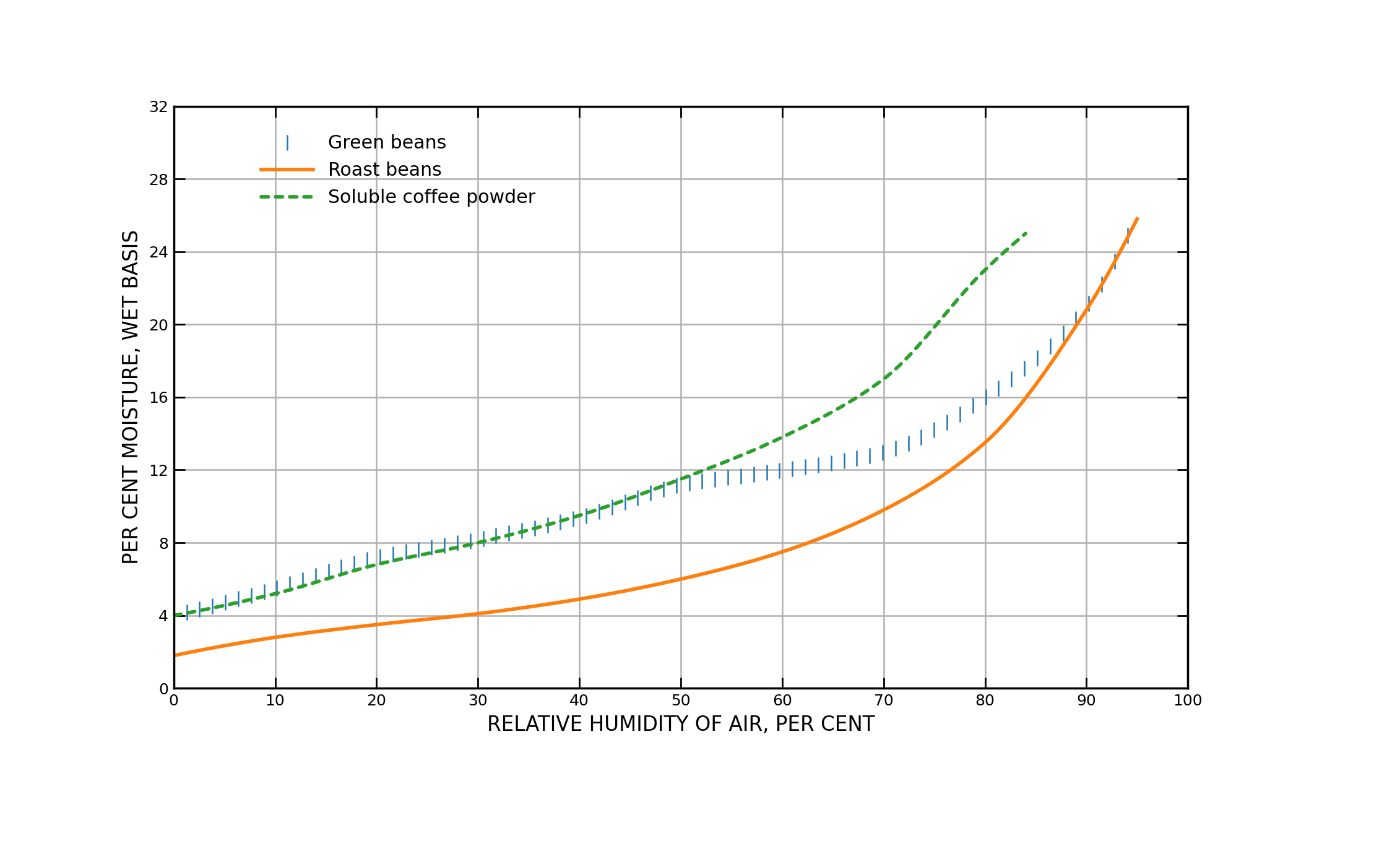
Green coffee is a hygroscopic matrix. It actively exchanges moisture with its environment until it reaches Equilibrium Moisture Content (EMC). This property is the single greatest risk during international transport.
The "Container Rain" Effect
During ocean freight, containers are subject to extreme temperature fluctuations (e.g., cold nights in the Southern Hemisphere to hot days in the tropics). These swings cause the relative humidity inside the container to fluctuate, leading to condensation on the bean surface. Even if the bulk moisture is safe (11%), this surface moisture spikes local aW, triggering localized mold growth and "wet spots."
Packaging Solutions
- Jute Bags: Traditional jute bags are porous, allowing the coffee to breathe but also to absorb ambient humidity. Coffee in jute bags rapidly absorbs moisture in humid ports.
- Hermetic Packaging: Coffee in hermetic packaging (e.g., GrainPro, Vacuum packed) remains stable.
Storage in Parchment
Research indicates that storing coffee in parchment offers superior protection compared to green coffee storage. The parchment layer acts as a physical barrier to moisture and oxygen, slowing respiration and preserving viability. Coffee in parchment can retain viability for up to a year, whereas green coffee can lose 50% viability within 3 months under suboptimal conditions.
Chemical Degradation Pathways
Improper moisture management reactivates metabolic and chemical degradation pathways that irreversibly damage flavor.
- Respiration: If moisture and temperature are too high, the seed resumes respiration, consuming stored sucrose and lipids to produce CO2, water, and heat. This exothermic reaction creates a feedback loop, accelerating decay. The loss of sucrose directly correlates to a loss of sweetness and the development of "woody" or "papery" flavors.
- Lipid Oxidation: Coffee lipids (approx. 15% in Arabica) are susceptible to hydrolysis. High humidity and temperature accelerate the breakdown of triglycerides into free fatty acids, leading to rancidity.
- Enzymatic Browning: Polyphenol oxidase activity, influenced by membrane permeability changes from moisture stress, degrades chlorogenic acids (CGAs). CGAs are key precursors for acidity and antioxidant capacity. Their degradation diminishes the coffee's brightness and complexity, leading to the "faded" cup profile associated with old or improperly stored coffee.
References
- Demianová, A., et al. (2023). "Moisture Content and Its Possible Effect on Textural Properties and Color of Green Coffea arabica." Journal of Microbiology, Biotechnology and Food Sciences. DOI: 10.55251/jmbfs.9491
- Vanâsia, M. C., Nogueira, R. M., & Koziorowski, T. (2018). "Roasting Equipment and Coffee Processing." In Coffee: Emerging Health Effects and Disease Prevention. Taylor & Francis. DOI: 10.1201/9781315113104-8
- University of Hawaii at Manoa. "Coffee Quality and Moisture Content Research." ScholarSpace. Link to Repository
- Wintgens, J. N. (Ed.). (2004). Coffee: Growing, Processing, Sustainable Production. Wiley-VCH.
- Royal Coffee. "The Theory of Relative Humidity." Roast Magazine, May/June 2025.
- Songer and Associates. "Summary of Coffee Technical Literature Regarding Green Bean Moisture and Color." (2013).