
Responsibility Report · 2024–2026
Where your
money goes.
This is not a marketing document. It is an accounting. Every lot. Every price. Every cost between the farm and your roastery.
Fairness begins with clarity. If we cannot explain where the money goes, we cannot speak about ethics.
4
Origins
60+
Lots documented
~10
Years of partnerships
27,429
kg · 2024–2026
01
Why this report exists
Green coffee has been treated like a commodity for too long. Bought, sold, speculated on — with no honest account of what each player in the chain actually received. We are building something different. It starts here.
The specialty coffee industry talks a lot about transparency. Most of it is performance. A sentence on a bag. A phrase on a website. A number without context.
We share three prices for every lot we import — because one number is not enough. The farm gate price tells you what the producer received. The FOB price tells you what was agreed at the point of export. The ex-warehouse price tells you what you pay, and what we absorb to get it there.
The gap between farm gate and ex-warehouse is not profit. It is logistics, currency conversion, dry milling, port fees, freight, insurance, customs clearance, sample distribution, storage. We explain it because you deserve to know — and because producers deserve partners who can explain it.
The commodity market is volatile by design. It rewards speculation, not loyalty. Small-scale producers face rising fertilizer costs, labour scarcity, climate volatility — yet are expected to accept prices that rarely reflect true cost of production. This report is our answer to that system.
All prices in this report are expressed in USD per pound (lb) unless noted. FOB = Free on Board, the last agreed price before coffee leaves the origin country. Farm Gate = what the producer received. Ex-Warehouse = delivered price to the buyer's nearest warehouse, including all import costs.
02
Three prices. All visible.
What we
measure
Farm Gate $/lb
What the producer earns.
The price received by the coffee producer — after processing, but before export-related costs. This is the number that matters most. It must reflect rising fertilizer costs, labour scarcity, climate pressure, and a fair return on skilled work. We never negotiate this number down. We work with exporters to find balance when costs rise.
FOB $/lb
What we commit to at origin.
Free on Board — the agreed price once coffee is milled, bagged, ICO-marked, and loaded at the port of origin. Includes dry milling, export permit, packing, domestic transport, and IHCAFE or ICAFE escrow where applicable. This is our contractual commitment. It is the price against which we are held accountable by the Transparency Pledge.
Ex-Warehouse $/lb
What you pay, fully landed.
The price you see includes FOB plus international freight, marine insurance, destination port fees, customs clearance, import duties where applicable, and delivery to the warehouse closest to you. The difference between FOB and ex-warehouse is never hidden — it is the true cost of getting specialty coffee safely across an ocean, through customs, and into storage.
Price anatomy — every lot
Farm Gate ($/lb) + Export costs = FOB ($/lb)
FOB ($/lb) + Freight · Insurance · Import · Customs · Storage = Ex-Warehouse ($/lb)
Average import/export cost range across this report: $0.48 – $2.89 / lb
Higher per-lb import costs reflect smaller lot sizes, longer freight routes (e.g. Gothenburg), or currency volatility in the booking period.
03
The numbers, by origin
Every lot.
Every price.
These are real prices from real contracts. Lots are identified by producer, variety, process, and our internal lot code. Prices reflect the calendar year indicated in the code (22 = 2022 crop, 23 = 2023, 24 = 2024, 25 = 2025).
Farm Gate
FOB premium
Import & logistics cost
| Producer / Farm | Variety | Process | Code | Warehouse | Farm Gate | FOB | Ex-WH | Import cost | Price bar |
|---|---|---|---|---|---|---|---|---|---|
| Familia Salazar – Los Cipreses | SL28 | Honey | 23-COS-LC-SL28_H | Seaforth, BC | $9.00 | $10.00 | $12.21 | +$2.21 | |
| Familia Salazar – Los Cipreses | Milenio | Honey | 23-COS-LC-ML_H | Seaforth, BC | $6.00 | $7.00 | $8.81 | +$1.81 | |
| Jhon Alvarado – Corazón de Jesús | CellPeaberry | Natural | 23-COS-CJ-PB_N | Seaforth, BC | $4.00 | $5.00 | $6.21 | +$1.21 | |
| Max Salazar – San Cristóbal | SL28 | Honey | 23-COS-SC-SL28_H | Seaforth, BC | $5.00 | $6.00 | $7.79 | +$1.79 | |
| Max Salazar – San Cristóbal | SL28 | Natural Anaerobic | 23-COS-SC-SL28_NA | Seaforth, BC | $5.00 | $6.00 | $7.79 | +$1.79 | |
| Cafetalera Orígenes | African variety blend | Natural | 23-COS-CO-AFR_N | Seaforth, BC | $5.00 | $6.00 | $7.23 | +$1.23 | |
| change of tone. blender – Tarrazú | Caturra | Washed | 24-COS-COT-TR_W | Seaforth, BC | $2.95 | $3.10 | $4.07 | +$0.97 | |
| Don Senel Campos – La Toboba | Gesha | Natural | 24-COS-LT-GS_N | Seaforth, BC | $9.00 | $10.00 | $10.97 | +$0.97 | |
| Don Senel Campos – La Toboba | Obata | Natural | 24-COS-LT-OB_N | Seaforth, BC | $4.30 | $5.30 | $6.27 | +$0.97 | |
| Cafetalera Orígenes | SL28 | Honey | 24-COS-CO-SL28_H | Seaforth, BC | $6.50 | $7.50 | $8.47 | +$0.97 | |
| Cafetalera Orígenes | ET47 | Honey | 24-COS-CO-ET47_H | Seaforth, BC | $6.50 | $7.50 | $8.47 | +$0.97 | |
| Jhon Alvarado – Corazón de Jesús | Taka | Washed | 24-COS-CJ-TK_W | Seaforth, BC | $9.50 | $10.50 | $11.47 | +$0.97 | |
| Jhon Alvarado – Corazón de Jesús | Peaberry | Natural | 24-COS-CJ-PB_N | Seaforth, BC | $3.75 | $4.00 | $4.97 | +$0.97 | |
| Familia Salazar – Los Cipreses | Gesha & Milenio | Nat. Double Anaerobic | 24-COS-LC-GSML_DNA | Seaforth, BC | $9.00 | $10.00 | $10.97 | +$0.97 | |
| Familia Salazar – Los Cipreses | Gesha & Milenio | Natural Anaerobic | 24-COS-LC-GSML_NA | Seaforth, BC | $9.00 | $10.00 | $10.97 | +$0.97 | |
| Familia Salazar – Los Cipreses | Gesha | Honey Anaerobic | 24-COS-LC-GS_HA | Seaforth, BC | $11.00 | $12.00 | $12.97 | +$0.97 | |
| Familia Salazar – Los Cipreses | Caturra | Honey | 24-COS-LC-CR_H | Seaforth, BC | $4.50 | $5.50 | $6.47 | +$0.97 | |
| Familia Salazar – Los Cipreses | Milenio | Honey | 24-COS-LC-ML_H | Seaforth, BC | $6.00 | $7.00 | $7.97 | +$0.97 | |
| Familia Salazar – Los Cipreses | SL28 | Natural | 24-COS-LC-SL28_N | Seaforth, BC | $11.00 | $12.00 | $12.97 | +$0.97 | |
| Familia Salazar – Los Cipreses | Milenio | Honey Anaerobic | RCR25COT1 | Gothenburg, SE | $7.30 | $8.30 | $10.54 | +$2.24 | |
| Familia Salazar – Los Cipreses | Casopeia | Honey Anaerobic | RCR25COT2 | Gothenburg, SE | $8.30 | $9.30 | $11.69 | +$2.39 | |
| Familia Salazar – Los Cipreses | SL28 | Natural | RCR25COT3 | Cell | $8.80 | $9.80 | $12.28 | +$2.48 | |
| Familia Salazar – Los Cipreses | Milenio | Honey | RCR25COT4 | Gothenburg, SE | $6.50 | $7.50 | $9.61 | +$2.11 | |
| Don Senel Campos – La Toboba Anonas | Catuai | Red Honey | RCR25COT5 | Gothenburg, SE | $4.25 | $5.25 | $7.00 | +$1.75 | |
| Don Senel Campos – La Toboba | Blend | Yellow Honey | RCR25COT6 | Gothenburg, SE | $3.80 | $4.80 | $6.47 | +$1.67 | |
| Don Senel Campos – La Toboba | Catigua | Natural | RCR25COT7 | Gothenburg, SE | $5.00 | $6.00 | $7.87 | +$1.87 | |
| Don Senel Campos – La Toboba | Gesha | Natural | RCR25COT8 | Gothenburg, SE | $7.30 | $8.30 | $10.54 | +$2.24 | |
| La Torre – Corazón de Jesús | Gesha | Red Honey | RCR25COT9 | Gothenburg, SE | $11.35 | $12.35 | $15.24 | +$2.89 | |
| Alvarado Fonseca – Corazón de Jesús | Peaberry | Anaerobic Natural | RCR25COT10 | Gothenburg, SE | $3.25 | $4.25 | $5.84 | +$1.59 | |
| Cafetalera Orígenes | San Roque | Black Honey | RCR25COT11 | Gothenburg, SE | $6.00 | $7.00 | $9.03 | +$2.03 | |
| Cafetalera Orígenes | SL28 | Black Honey | RCR25COT12 | Gothenburg, SE | $7.00 | $8.00 | $10.19 | +$2.19 |
Lots warehoused in Seaforth, BC (Canada) and Gothenburg, Sweden. Higher import costs on Sweden lots reflect transoceanic routing plus European port fees and extended handling. All Costa Rica lots scored 86.5–89.25 CoE.
| Producer / Farm | Variety | Process | Code | Qty | Farm Gate | FOB | Ex-WH | Import cost | Price bar |
|---|---|---|---|---|---|---|---|---|---|
| Rene Fernandez – Las Huellas | Parainema B | Washed | 24-HON-LH-PN_W | 11×69 | $3.46 | $4.25 | $4.90 | +$0.65 | |
| Rene Fernandez – Las Huellas | Parainema C | Washed | 24-HON-LH-PN_W2 | 14×69 | $3.46 | $4.25 | $4.90 | +$0.65 | |
| Pedro Lopez – La Sabila | Pacas | Washed | 24-HON-LS-PC_W | 3×69 | $4.11 | $4.90 | $5.55 | +$0.65 | |
| Eduin Fernandez – La Pantera | Pacas/Catuai | Washed | 24-HON-LP-PCCT_W | 3×69 | $3.71 | $4.50 | $5.15 | +$0.65 | |
| Benjamin Paz – La Salsa | Pacas | Washed | 24-HON-LS-PC_W | 5×69 | $3.71 | $4.50 | $5.15 | +$0.65 | |
| Arturo Paz – Mezcla Guaco | Pacas | Washed | 24-HON-MG-PC_W | 5×69 | $3.71 | $4.50 | $5.15 | +$0.65 | |
| Elio Diaz – Finca Anabel | Bourbon | Washed | 24-HON-FA-BR_W | 5×69 | $3.96 | $4.75 | $5.40 | +$0.65 | |
| Elio Diaz – Finca Anabel | Pacas | Washed | 24-HON-FA-PC_W | 3×69 | $3.71 | $4.50 | $5.15 | +$0.65 | |
| Kelvin Pineda – La Arianita | Bourbon | Washed | 24-HON-LA-BR_W | 2×69 | $3.96 | $4.75 | $5.40 | +$0.65 | |
| Arturo Paz – El Tango | Geisha | Washed | 25-HON-ET-GS_AW | 6×30 | $14.21 | $15.00 | $15.48 | +$0.48 | |
| Arturo Paz – El Guaco | Pacas | Washed | 25-HON-ET-PC_AW | 5×30 | $4.71 | $5.50 | $5.98 | +$0.48 | |
| Benjamin Paz – La Salsa | SL28 | Washed | 25-HON-LS-SL_AW | 4×30 | $5.71 | $6.50 | $6.98 | +$0.48 | |
| Elio Diaz – Finca Anabel | Pacas | Washed | 25-HON-PA-PC_W | 6×69 | $4.71 | $5.50 | $5.98 | +$0.48 | |
| Kelvin Pineda – La Arianita | Pacas – COT Experiments | Hybrid Washed | 25-HON-LA-PC_EAW | 5×69 | $5.21 | $6.00 | $6.48 | +$0.48 | |
| Kelvin Pineda – La Arianita | Pacas – Arianita | Washed | 25-HON-LA-PC_AW | 13×69 | $4.96 | $5.75 | $6.23 | +$0.48 | |
| Kelvin Pineda – La Arianita | Pacas | Washed | 25-HON-LA-PC_W | 21×69 | $4.96 | $5.75 | $6.23 | +$0.48 | |
| Rene Fernandez – Las Huellas | Parainema | Washed | 25-HON-LH-PN_W | 20×69 | $4.46 | $5.25 | $5.73 | +$0.48 | |
| Eduin Fernandez – La Pantera | Pacas | Washed | 25-HON-LP-PC_W | 4×69 | $4.71 | $5.50 | $5.98 | +$0.48 | |
| Pedro Lopez – La Sabila | Bourbon | Washed | 25-HON-PL-BR_W | 3×69 | $4.46 | $5.25 | $5.73 | +$0.48 | |
| San Andrés – Regional Blend | Blend | Washed | 25-HON-SA-BL_W | 188×69 | $3.51 | $4.30 | $4.78 | +$0.48 |
All Honduras lots washed process, warehoused Seaforth, BC. 2025 lots show lower import/export cost ($0.48/lb) vs 2024 ($0.65/lb) reflecting improved container booking efficiency on the Pacific consolidation route.
| Producer / Farm | Variety | Process | Code | Warehouse | Farm Gate | FOB | Ex-WH | Import cost | Price bar |
|---|---|---|---|---|---|---|---|---|---|
| Maria Eugenia – La Huerta | Bourbon/Typica | Washed | 24-NIC-LH-BRT_W | Green Room, US | $3.50 | $4.00 | $4.80 | +$0.80 | |
| Maria Eugenia – La Huerta | Bourbon/Typica | CM Natural | 24-NIC-LH-BRT_CMN | Green Room, US | $5.50 | $6.00 | $4.80 | +$0.80 | |
| Claudia Lovo – El Árbol | Catimor | CM Natural | 24-NIC-EA-CT_CM | Green Room, US | $6.00 | $6.00 | $4.80 | +$0.80 | |
| Claudia Lovo – El Árbol | Maracaturra | CM Natural | 24-NIC-EA-MT_CM | Green Room, US | $7.50 | $7.50 | $4.80 | +$0.80 |
Nicaragua lots through Green Room, US. Carbonic maceration (CM) commands a meaningful premium over washed — reflecting the infrastructure investment and precision required at Finca El Árbol and La Huerta. Note: El Árbol CM lots show farm gate = FOB, indicating no additional export margin retained between producer and export.
| Producer / Farm | Variety | Process | Code | Qty | Farm Gate | FOB | Ex-WH | Import cost | Price bar |
|---|---|---|---|---|---|---|---|---|---|
| Ashok Patre – Ratnagiri Estate | Colombia | Anaerobic Washed | 22-IND-RE-CL_AW | 13×30 | $5.00 | $5.00 | $6.66 | +$1.66 | |
| Ashok Patre – Ratnagiri Estate | Cauvery | Anaerobic Natural | 22-IND-RE-CV_AN | 14×30 | $4.00 | $4.00 | $5.49 | +$1.49 | |
| Ashok Patre – Ratnagiri Estate | Catuai | Anaerobic Honey | 22-IND-RE-CT_AH | 15×30 | $4.85 | $4.85 | $6.48 | +$1.63 | |
| Ashok Patre – Ratnagiri Estate | Cauvery | Natural | 22-IND-RE-CV_N | 21×30 | $5.00 | $5.00 | $6.48 | +$1.48 | |
| Ashok Patre – Ratnagiri Estate | Chandragiri | Natural | 22-IND-RE-CH_N | 5×30 | $5.00 | $5.00 | $6.66 | +$1.66 |
All India lots: Ratnagiri Estate, Karnataka. Ashok Patre retains full FOB — farm gate equals FOB across every lot. The vertically integrated operation — from nursery to dry mill — allows Ashok to eliminate export intermediaries. Higher import costs ($1.48–1.66/lb) reflect the longer shipping distance from India to BC.
04
The cost between farm and warehouse
What the
import cost covers
The gap between FOB and ex-warehouse is not our margin. It is the cost of moving specialty coffee safely across an ocean, through customs, and into temperature-controlled storage near you.
These costs are real, they are variable, and they have been rising. Since 2021, ocean freight has never fully returned to pre-pandemic stability. Container shortages, port congestion, Panama Canal low-water events, and currency volatility on CAD/USD and EUR/USD have all affected the numbers you see in this report.
We share these costs not to complain — but because every coffee buyer deserves to understand what they are paying for.
International Ocean Freight
Container booking from origin port to Vancouver, Gothenburg, or US Gulf. Rate varies by origin, route, and market conditions. The largest single variable in import cost.
~40%
Marine Insurance
All-risk coverage for green coffee in transit. Water activity risks during shipping — temperature fluctuation across the equator — make this non-negotiable.
~8%
Port Fees · Customs · Clearance
Destination port handling, biosecurity inspection, customs documentation, and broker fees. Canadian and EU import processes differ significantly from US.
~22%
Drayage · Warehouse Delivery
Container delivery from port to warehouse. Unloading, palletizing, intake into climate-controlled storage at 18–22°C / 50% humidity.
~18%
Sample Distribution · QC
Moisture, density, and water activity verification on every lot. Sample grinding, packaging, and courier to roasters for pre-purchase approval.
~10%
Financing Costs
Forward contracts require capital deployment before coffee ships — sometimes months before invoice settlement. Bank financing, letters of credit, and interest charges on pre-shipment capital are real costs embedded in every lot. With central bank rates elevated across CAD, USD, and EUR since 2022, this line has grown substantially.
~2%
We absorb currency risk between booking and invoice settlement. The CAD/USD rate at booking (as low as 0.71 CAD in recent years) versus settlement can swing the effective import cost per pound by $0.15–0.30 CAD — before a single container moves. Financing costs compound this: forward contracts deployed at 6–7% annual interest rates add a further $0.03–0.08/lb depending on lot size and settlement timeline.
05
This report in numbers
The numbers
that matter
$4.00–$15.00
FOB range per lb
(USD, 2024–2026)
$3.25–$14.21
Farm gate range per lb
(USD, 2024–2026)
$0.48–$2.89
Import / export cost
per lb across all lots
86–89.25
CoE score range
across this portfolio
C-Market context — why these numbers matter
C-Market (commodity) benchmark, April 2026: approx. $3.20 – $3.60 / lb
Our portfolio average FOB: approx. $6.50 – $7.50 / lb (excluding volume blend lots)
Our portfolio average farm gate: approx. $5.50 – $6.50 / lb
06
The people behind the numbers
Producer
partnerships
Every price in this report has a person behind it. Someone who grew the coffee, processed it, dried it, and sent it across an ocean on the basis of a commitment made before the harvest. Some of these relationships span a decade. Their stories are inseparable from the numbers.
Costa Rica · Naranjo, West Valley · 1,600–1,650 masl
Familia Salazar
Familia Salazar · Los Cipreses
Cristian and Greivan Salazar. Named after the cypress trees on a partner farm, sold as Christmas trees each December. CoE participants. Their Gesha Honey Anaerobic — $12.00 FOB, $11.00 farm gate — represents the ceiling of what SL28 and Gesha can achieve in West Valley microclimate. No herbicides. Mulching only.
$7.50–$12.00
FOB range / lb
SL28, Gesha,
Caturra, Milenio
Varieties
Costa Rica · Pérez Zeledón · 1,840–1,900 masl
Don Senel Campos
La Toboba · Anonas
Don Senel is one of the newer relationships in our Costa Rica network and one of the most exciting. La Toboba produces a range of varieties — Gesha, Obata, Catuai, Catigua, Blend — across Yellow Honey, Red Honey, and Natural processes. In 2025 we shipped his lots to Gothenburg for the first time. Each lot carries distinct terroir character at altitude. A producer building quality with discipline.
$5.25–$8.30
FOB range / lb
Gesha, Obata,
Catuai, Catigua
Varieties
Costa Rica · Chirripó, Brunca · 1,800–1,950 masl
Jhon Alvarado Abarca
Corazón de Jesús / La Torre
CoE 2024 finalist — 2nd place honeys & naturals, 92 points. La Torre's Gesha at 1,950 masl commands our highest Costa Rica price: $12.35 FOB, $11.35 farm gate. The pre-dried Gesha protocol — allowing extended drying before processing — took years to perfect. It shows in every cup.
$4.00–$12.35
FOB range / lb
Gesha, Peaberry,
Taka, Typica
Varieties
Honduras · Santa Barbara, Las Flores · 1,380–1,760 masll
Rene Fernandez
Las Huellas
Rene's grandfather was among the first settlers in the mountains of Santa Barbara. We co-sponsored the construction of his drying facility in 2018 — a rail-system parabolic dryer designed for optimal airflow and moisture control. His Parainema variety, planted on seeds passed from Juan Evangelista Fernandez, is now one of Santa Barbara's most recognizable profiles.
$4.25–$5.25
FOB range / lb
Parainema
Varieties
Honduras · Santa Barbara · High Altitude Experimental
Arturo Paz
El Tango Geisha · El Guaco
The highest-priced Honduras lot in this report — El Tango Geisha at $15.00 FOB, $14.21 farm gate. Not a number we arrived at lightly. Geisha in Santa Barbara at this altitude, washed and clean, is genuinely exceptional. Benjamin Paz's SL28 lot at $6.50 FOB represents the newer cultivar work being done across the family's farms.
$5.50–$15.00
FOB range / lb
Geisha, Pacas,
SL28
Varieties
Nicaragua · Dipilto, Ocotal · 1,100–1,250 masl
Claudia Lovo
Finca El Árbol
Claudia built El Árbol in 2015. Their carbonic maceration infrastructure is shared with neighbouring producers across Dipilto — an act of genuine community building that is rare in this industry. Farm gate equals FOB on their lots. 14 full-time workers. Moving toward fully organic. One of the most principled operations we have had the privilege to work with.
$6.00–$7.50
FOB range / lb
Catimor,
Maracaturra
Varieties
Honduras · Santa Barbara · La Salsa
Benjamin Paz
La Salsa · Beneficio San Vicente
Benjamin Paz is a producer, exporter, and a key figure in building Santa Barbara's reputation on the international stage. Through Beneficio San Vicente, he has supported dozens of producers in the region — including several in this report. His SL28 lot at $6.50 FOB represents serious cultivar work. The relationship with the Paz family is one of the longest and most formative in our network.
$5.50–$6.50
FOB range / lb
Pacas, SL28,
Bourbon
Varieties
Costa Rica · Pérez Zeledón, Brunca · 1,840–1,900 masl
Cafetalera Orígenes
Edgar Silva · Ricardo Azofeifa · Rebeca Moya
A project built from scratch with purpose. Orígenes is reinvesting all income into a processing facility with a cupping lab in the Brunca region. The African variety blend and SL28 lots from this farm are early chapters of a longer story. Their goal — connecting Costa Rican consumers with the coffees grown in their own country — mirrors what we try to do on the international side.
$7.00–$8.00
FOB range / lb
SL28, ET47,
African varieties
Varieties
Honduras · Santa Barbara, Las Flores · 1,380–1,500 masl
Kelvin Pineda
La Arianita
Kelvin Pineda is among the newer relationships in our Honduras network and among the most promising. La Arianita's Pacas lots show clean, defined profiles that hold well across multiple roast applications. We have been running processing experiments with Kelvin — the COT Hybrid Washed lot (25-HON-LA-PC_EAW) is the result of those conversations. He is the kind of producer who makes you want to come back next harvest.
$5.75–$6.00
FOB range / lb
Pacas,
Bourbon
Varieties
Honduras · Santa Barbara, Las Flores · 1,380–1,450 masl
Elio Diaz
Finca Anabel
Elio Diaz farms Bourbon and Pacas varieties on Finca Anabel, one of the most consistent washed lots in our Santa Barbara offering. His Bourbon — dates, orange chocolate, brown sugar, prune — holds its profile reliably across harvests. A producer who works with precision and communicates clearly. Exactly what a forward contract relationship requires.
$7.50–$$4.50–$4.75
FOB range / lb
Bourbon,
Pacas
Varieties
07
What we're dealing with
The honest
challenges
Transparency means speaking about difficulties, not only highlights and wins. These are the real operational challenges that influenced the numbers in this report — and that every specialty coffee buyer should understand.
01 · Currency
CAD / USD & EUR / USD volatility
Operating from Vancouver with USD-denominated FOB contracts creates constant currency exposure. At 0.71 CAD per USD (recent lows), a $1.00/lb FOB contract costs $1.41 CAD to settle — before freight. We absorb much of this risk rather than passing it directly to buyers. It is a structural cost of doing business between North America and Central America.
02 · Freight
Unstable ocean freight & container access
Since 2021, container availability on Central America-to-Canada routes has never fully normalised. Shipments are occasionally rolled to the next vessel. Transit times vary. The Panama Canal experienced low-water restrictions. Insurance costs rose with freight volatility. The $0.48–$2.89/lb import range in this report reflects this instability directly.
03 · Tariffs
2025 US tariff environment
New US tariff structures (10% baseline, with country-specific rates) directly affect any lots warehoused at Green Room, US (Nicaragua). Green coffee was not exempted in most categories. For roasters purchasing our Nicaragua lots from US storage, this adds cost that must be acknowledged honestly — not absorbed silently, not dismissed.
04 · Water Activity
Shipping risk to green coffee quality
Coffee crossing the equator in a sealed container is exposed to temperature swings of 20°C+. Water activity can shift during transit. We measure moisture content and water activity on every lot at origin (PSS stage) and on arrival. Lots that show movement outside acceptable range (Aw >0.65, moisture >12.5%) are flagged and discussed with the buyer before release.
05 · Labour
Harvest labour scarcity in Central America
Labour shortage during harvest season is not a future risk. It is a present reality across Honduras, Nicaragua, and Costa Rica. Pickers are harder to recruit, and wages must rise to attract them. This is embedded in rising farm gate prices — which is correct. Producers should not absorb this cost alone. We support it through our premium structure.
06 · Climate
Unpredictable drying seasons
At Ratnagiri, at Los Cipreses, at Las Huellas — all three experienced unusual rainfall patterns in 2023 and 2024 that disrupted planned drying windows. Moisture content on some lots shipped slightly higher than target. We communicated this at the PSS stage. We adjusted water activity protocols. We did not hide it.
07 · Rainfall
Unexpected rains at origin
Rainfall outside the historical seasonal window is no longer an anomaly — it is a pattern. In Honduras in 2024, rains arrived three weeks before the expected end of harvest, forcing an early close on some lots. In Costa Rica, unexpected precipitation during the drying phase elevated water activity on parchment already on the beds. This cannot always be corrected. Some coffee is lost. Some is downgraded. The cost is real and it falls first on producers.
08 · Banking
Increasing bank interest fees
Central bank rates across Canada, the US, and the EU remained elevated from 2022 through 2025. Letters of credit, pre-shipment financing, and working capital drawn against forward contracts all carry interest charges. At 6–7% annual rates, the financing cost on a $50,000 shipment held for 90 days before settlement is a meaningful number. It does not appear on the FOB invoice. It appears in our margin. We are not passing it fully to buyers, but it is real and it is rising.
09 · Inflation
Structural inflation across the chain
Fertiliser, fuel, labour, packaging, warehousing — every input cost in coffee has risen since 2021 and has not fully corrected. Producer input costs are embedded in farm gate prices, which is correct. But importer operating costs — warehouse fees, staffing, insurance, communications, logistics — have all increased. We absorb most of this rather than pass it to buyers. It is a squeeze that compounds quietly. It is also one of the reasons small, honest importers disappear from this industry.
09
Portfolio at a glance — graphically
Volume, value,
and time
Three views of this portfolio. Kilograms imported by country. Average farm gate paid per pound, by country. And the length of each producer relationship — because continuity is not an accident, it is a decision made again every year.
Kilograms imported · by country (this report period)
Honduras
21.9t
Costa Rica
9.0t
India
2.0t
Nicaragua
0.6t
Honduras volume is large partly due to the San Andrés regional blend — 188×69kg bags of washed Pacas that serve as an accessible, high-volume lot for roasters building a Honduras programme. All other origins reflect microlot and small-lot purchasing.
Average farm gate paid · by country (USD / lb)
Costa Rica
$7.18
Nicaragua
$5.63
India
$4.77
Honduras
$5.12
Costa Rica commands the highest average farm gate — reflecting altitude, processing complexity, and cultivar diversity. India's fully vertically integrated model means farm gate equals FOB; what you see is exactly what Ashok Patre receives.
Length of producer relationships · years active as of 2026
Arturo & Benjamin Paz
(Honduras)
10 yrs
Finca El Árbol · Claudia Lovo
(Nicaragua)
9 yrs
Finca Anabel · Elio Diaz
(Honduras)
8 yrs
Rene Fernandez · Las Huellas
(Honduras)
8 yrs
Familia Salazar · Los Cipreses
(Costa Rica)
7 yrs
Jhon Alvarado · Corazón de Jesús
(Costa Rica)
6 yrs
Cafetalera Orígenes
(Costa Rica)
4 yrs
Don Senel Campos · La Toboba
(Costa Rica)
3 yrs
Maria Eugenia · La Huerta
(Nicaragua)
3 yrs
Year one is always a trial. Year three is a commitment. Year seven is something else entirely — a vocabulary, a shared set of expectations, a producer who knows your palate and you know their harvest challenges before they tell you. These timelines are not marketing. They are the actual record.
10
The system we operate in
Colonialism, speculation,
and the C-Market
To understand why transparency reports exist — why they are necessary rather than optional — you have to understand the system they are responding to.
The global coffee commodity market is not a neutral mechanism. It is a structure built in a specific time, by specific actors, in the service of specific interests. Understanding that history does not require cynicism. It requires honesty about how value has flowed — and continues to flow — in the coffee trade.
Coffee is one of the most traded commodities in the world. Roughly 170 million bags are produced annually. Almost all of it is grown in countries that were colonies of European powers during the period when their coffee industries were established. Almost all of it is consumed in countries that were not. The economic architecture of coffee trade — who sets prices, where trading happens, what currencies are used — was built during colonialism and has not been fundamentally restructured since.
"The price on the exchange has nothing to do with the cost of growing coffee. It never did."
The C-Market (Coffee "C" futures contract) was introduced at the New York Board of Trade in 1882. It established a mechanism for trading coffee at standardised prices without reference to origin quality, producer cost, altitude, or variety. It was designed for volume. For predictability in large commercial transactions. It was never designed to reflect the true cost of production at the farm level.
A brief history of how prices were decoupled from producers
1882
The C-Market is established in New York
Coffee futures trading begins on the New York Coffee Exchange. Prices are set through speculative trading in consuming countries — not in producing countries. The structural disconnect between where coffee is grown and where its price is determined is built into the system from day one.
1962–1989
The International Coffee Agreement — a brief correction
Producing and consuming nations agree to a quota system that stabilises prices. For nearly three decades, coffee farmers in Central America, Africa, and Asia receive prices that are broadly predictable. It is not a perfect system, but it is one that acknowledges producer interests as legitimate. Many of the farms we work with today were established and developed during this period of relative stability.
1989
The ICA collapses — prices fall by 50% in twelve months
The United States withdraws from the International Coffee Agreement. The quota system collapses. Within twelve months, global coffee prices fall by more than 50%. Hundreds of thousands of small-scale producers in Central America — including in the regions where we now work — lose their income almost overnight. Many abandon coffee entirely. The social disruption in Honduras, Nicaragua, and Costa Rica during the 1990s is directly connected to this price collapse. The specialty coffee movement, which emerged in this same period, is partly a response to it.
1990s–2000s
Structural adjustment and export dependency
International Monetary Fund structural adjustment programmes require coffee-producing nations to increase exports and reduce state support for farmers. The result is a further squeeze on producer margins. Coffee-growing countries are locked into export dependency — growing a product whose price they do not control, for markets they cannot easily access, in currencies that are not their own. The C-Market reflects none of this. It reflects the mood of traders in New York and London.
2018
The C-Market touches $0.98/lb — below cost of production
On August 20, 2018, the C-Market price for green coffee drops to $0.98/lb — the lowest level since 2006. The cost to produce one pound of specialty-grade coffee is between $1.05 and $1.40/lb. At this price, most farms that sell at commodity pricing are running at a loss. Labour — which accounts for roughly 70% of total production cost in most origins — is being compensated below any reasonable living wage standard. This is the system we refuse to use as a price benchmark.
2024–2026
The C-Market spikes — but producers don't benefit equally
By late 2024, the C-Market has swung to historic highs — driven by supply shocks in Brazil and Vietnam, compounded by financial speculation during a period of macro-economic uncertainty. The price movement is dramatic. But the producers who suffered through the $0.98/lb period did not benefit proportionally from the upswing. Many had already left the industry. Others had taken on debt to survive. The volatility is the problem — not any single price level. A system that punishes producers in bad years and fails to reward them adequately in good years is a system designed for traders, not growers.
How financial speculation works against producers
Even though we — along with other specialty roasters and importers — buy coffee outside the C-Market, there is no denying that commodity price indexes continue to shape negotiations across the entire industry. The fundamental problem is that these indexes do not account for the differing quality, altitude, processing method, or human investment behind individual coffees. Yet they directly affect the price coffee commands at every level of the chain.
The C-Market relies heavily on speculation and short-term positioning. Many of the major players involved are financial institutions using short-term projections, operating on a "buy low, sell high" model that has nothing to do with agronomy or harvest quality. A major consequence of this volatility is that the financial sector has largely stopped providing loans to small-scale producers — because lenders cannot price the risk in a market this unstable. That capital drought ripples across the entire coffee sector. Farms cannot invest. Quality stagnates. Producers leave.
When a fund takes a short position on coffee, it can trigger price movements that directly affect what producers are offered for their harvest. The producer has no visibility into this. They cannot hedge against it. They cannot opt out. They simply absorb the consequence. Forward contracting — the model we use — is a partial but meaningful answer: when we commit to a price before the harvest, we remove the producer from that exposure entirely.
There is no simple solution to the C-Market controversy. It is a long-term process that will require commitment from the broader specialty coffee industry. A good starting point is increased access to information — honest dialogue between importers, exporters, roasters, and retailers about what specialty coffee actually costs. Without that conversation, specialty coffee will continue to be priced against a benchmark that has no relationship to its true cost of production. The commodity market cannot be compared to specialty coffee. These are different things. The sooner the industry prices them accordingly, the better.
How the C-Market price compares to our farm gate
C-Market low (Aug 20, 2018): $0.98 / lb
Cost to produce 1 lb specialty coffee: $1.05 – $1.40 / lb
Labour share of production cost: ~70%
Our lowest farm gate in this report: $2.95 / lb (Tarrazú blend)
Our average farm gate across 2024 lots: ~$6.00 / lb
Our highest farm gate (La Torre Gesha 2025): $14.21 / lb
At $0.98/lb, most farms selling at commodity pricing were running at a loss. Workers received below living wage. It no longer made sense for those people to continue growing coffee. We do not benchmark against this price. We refuse it.
We believe an open and honest dialogue throughout the coffee buying community is essential to achieving a healthy, stable market. Without change, access to great coffees will decrease and fewer opportunities for producers will arise. We are committed to being part of that dialogue — through this report and every contract we sign.
C-Market price history · 2018–2026
The price per pound of green coffee on the ICE futures exchange (US cents/lb), monthly average. Our farm gate prices are shown alongside for comparison. The gap is not accidental — it is our position.
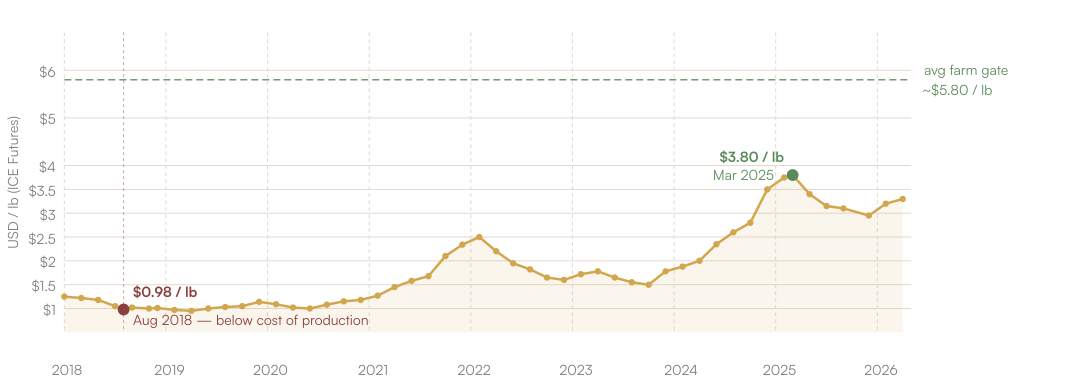
C-Market ($/lb)
Our avg farm gate ($/lb)
What this means for the producers we work with
Rene Fernandez's grandfather was among the first settlers in the mountains of Santa Barbara in the 1970s — before roads existed. The farm was established during the ICA period, when prices were stable enough to build on. The 1989 collapse hit farms like his directly. The survival of that farm through the 1990s, through cycles of rust, drought, and price volatility, is not a story of policy support. It is a story of endurance.
Ashok Patre's family acquired Ratnagiri Estate from British colonial officials in 1927. The British coffee industry in India was an extractive colonial enterprise — coffee was grown for export to British markets, with value accruing in London, not Karnataka. The farm Ashok now runs, with stainless steel fermentation tanks and a microbiology lab, is a different project entirely. But it exists on land whose history carries that weight.
Claudia Lovo built Finca El Árbol in 2015 in a country whose coffee sector has been shaped by decades of political instability, structural adjustment, and US foreign policy. She did it anyway. She built carbonic maceration infrastructure not just for her own lots but for neighbouring producers who couldn't access it alone. That is equity in practice, not in language.
We are not naive about the limits of what a small responsible importer can do. We are not going to restructure global commodity markets. But we can refuse to use them as a reference point. We can pay prices that reflect actual costs. We can commit before the harvest. We can share the numbers in a document like this one.
11
What continuity produces
Three
case studies
These are not success stories in the commercial sense. They are records of what happens when commitment is maintained through difficult years — when the relationship outlasts the bad harvest, the drought, the equipment failure, the price spike. Quality compounds. Trust compounds.
Rene Fernandez — Las Huellas
How a co-invested drying facility changed the quality ceiling of a Parainema lot
Infrastructure Investment
The context
Rene Fernandez farms at 1,380–1,760 masl in Las Flores, Santa Barbara — a region now synonymous with exceptional Honduran coffee, but one that was almost invisible to the international market a decade ago. His grandfather settled these mountains before roads existed. Rene received a plot at the highest elevation of La Maravilla farm and named it "Las Huellas" — the footprints.
When we first cupped Rene's coffee in 2016, the cup was promising. Parainema — a IHCAFE-developed Sarchimor hybrid, rust-resistant and high-yielding — was still being discovered by international buyers. The profiles were distinctive: lime juice, herbal notes, high acidity. But inconsistency in drying was creating variability lot to lot. The farm had limited infrastructure for controlled drying.
In 2018, we made a decision: co-invest in a new drying facility. Not as charity — as a structured commitment tied to our forward contract. The facility we helped fund featured a rail-system parabolic dryer with a moveable chair and trolley system, optimal airflow design, and capacity to separate lots at different drying stages. Built at the top of the farm, with a driveway to efficiently move coffee from harvest to drying.
Pre-investment (2016–2017)
Inconsistent drying · lot variation · moisture risk
Post-investment (2019–2026)
Controlled airflow · stable moisture exit · lot separation
FOB price (2024)
$4.25 / lb
FOB price (2025)
$5.25 / lb
What changed
The drying infrastructure changed two things directly. First: moisture control became consistent. Lots arriving at 10.5–11.5% moisture with water activity below 0.60 Aw — within target range across multiple shipments. Before, moisture variability created cupping inconsistency and occasional water activity concerns during transit.
Second: lot separation became possible. The rail system allows coffee from different plot sections and different pick dates to be dried separately, then cupped separately before blending or keeping as individual lots. This is where cup quality compounds. The ability to identify which part of the farm produced the best Parainema in a given harvest — and to track it — is what moves a producer from 86-point lots to 87.5-point lots. Not in one season. Over years.
In 2025, we contracted Rene's Parainema at $5.25 FOB — $5.73 ex-warehouse to Seaforth, BC. The farm gate is $4.46/lb. That is $1.00/lb above where we started. Over 20×69kg bags, the difference in farm gate translates to meaningful reinvestment capacity at origin.
Rene's coffee is now among the most consistent washed Parainema we can offer. The profile — plum, red grape, dark chocolate, walnut — has become reliable enough that roasters can programme around it. That reliability is worth something. It was built over eight years, not one good harvest.
The relationship
Rene has hosted us at his farm on multiple occasions. We have shared meals with his family. His children have grown up knowing that the coffee they help harvest goes to people who chose to come back, year after year, with a contract already signed. That is not a small thing in an industry built on short-term opportunism.
Ashok Patre — Ratnagiri Estate
From conventional Indian coffee to 170+ microlot experiments — what ten years of commitment makes possible
Innovation at Origin
The context
Indian specialty coffee was not widely recognised on the international stage when we began working with Ashok Patre. The dominant narrative was that Indian Arabica — grown under shade at moderate elevations in Karnataka and Tamil Nadu — was reliable but unexciting. Monsooned Malabar was what people knew. Specialty microlots were rare.
Ratnagiri Estate sits near Athigiri, close to Chikmagaluru, on the slopes of the Western Ghats at 1,000–1,500 masl near Bababudangiri — the place where Indian coffee is believed to have originated, brought by a Sufi pilgrim named Baba Budan from Yemen in the 17th century. Ashok's grandfather purchased the farm from British colonial officials in 1927 and spent fifteen years clearing and preparing the land.
When Ashok took over in 1989, he began a long-term transformation — but the most significant leap came in 2000 with investment in modern agricultural technology, and again in 2019 when he began fermenting coffee in anaerobic environments, designing and building his own stainless steel tanks for consistency and control.
2016 — characterisation
Conventional washed and natural · limited differentiation
2026 — characterisation
170+ microlot experiments · full vertical integration · 5 processes active
Farm gate (entry lot, 2022)
$4.00 / lb (Cauvery Anaerobic Natural)
Farm gate = FOB always
No export intermediary. Full price to Ashok.
What changed
Ashok cannot sit still. That is not a criticism — it is the single most important fact about Ratnagiri. The stainless steel anaerobic tanks he designed in 2019 produced results that surprised even seasoned cuppers. White pepper, chai, cacao — flavour compounds from Indian terroir that washed processing had been suppressing for decades, emerging cleanly through controlled fermentation.
The infrastructure that followed: tiled fermentation surfaces to prevent uncontrolled bacterial activity. Ventilated greenhouses for drying, controlling temperature and airflow across Karnataka's variable climate. Layered African-style drying beds under mesh to slow the drying process and protect water activity. A dry milling facility — the biggest investment in the estate's history — allowing full vertical integration. Defect sorting, screen sizing, and density separation now happen in-house before export.
The result is that every lot from Ratnagiri we receive has been through quality control at multiple stages by the same person who grew it. Mahesh, the farm manager, whose children's education and health insurance Ratnagiri has been financing since the early days of the relationship — oversees processing with a precision that shows in the cup.
Farm gate equals FOB on every India lot in this report. There is no export margin retained between producer and export. What we pay at FOB goes directly to Ashok's accounts. The import cost ($1.48–1.66/lb) reflects the longer freight route from India to BC — a structural reality we absorb because the quality justifies it.
The relationship
We were lucky to learn and experiment with Ashok directly. What he has built at Ratnagiri is a standard for Indian specialty coffee. The fact that it happened on a farm whose land was acquired from British colonial officials — and is now producing coffees that European and North American roasters pay a meaningful premium for — is not lost on us. The direction of value has changed. That matters.
Familia Salazar — Los Cipreses
From cooperative selling to Cup of Excellence finalist — what selective buying and lot separation actually means
Quality Compounding
The context
For over four decades, the Salazar family sold their coffee to local cooperatives, as most farmers in Naranjo's West Valley did. Traditional practices, collective pricing, no direct relationship with roasters or importers. In 2018, driven by market volatility and a desire for stability, they began exploring international direct trade — and partnered with 100LIBRAS before we found them through a blind cupping table.
Cristian Salazar's SL28 and Caturra lots were among the most aromatic we had tasted from West Valley. The microclimate at 1,600–1,650 masl — drier than Central Valley, strong Pacific winds, specific varieties maturing at a slower pace — was producing flavour profiles with body and texture that distinguished them from Tarrazú or Brunca coffees.
What the farm did not yet have was the infrastructure for true lot separation at the micro level, or access to processing their own cherry. They were selling to a shared wet mill. Good processing, but shared — meaning the identity of individual farm lots was lost in the collective.
Pre-2019
Cooperative selling · shared wet mill · no direct relationship
2026
Own micro-mill · CoE finalist · 10+ varietal lots exported
Varieties available (2019)
Caturra, SL28 — 2 lots
Varieties available (2025)
SL28, Milenio, Gesha, Caturra, Casopeia, Rume Sudan — 12+ lots
What changed
After their first Cup of Excellence success, Cristian invested in dedicated processing infrastructure — wet mill, fermentation, and drying. One of the cleanest and most meticulous operations we have visited anywhere. No herbicides. Weed control by mulching only. Lot separation by plot, by variety, by process. The ability to track exactly which trees produced which cherry, which fermentation tank held which lot, which drying bed carried which parchment.
That separation is what makes a document like this report possible. Without it, we cannot tell a roaster which lot to buy for espresso, which for filter, which for a seasonal natural release. Without it, we cannot justify the price difference between a $4.50/lb Caturra Honey and a $12.00/lb Gesha Honey Anaerobic. The cup explains it. The infrastructure creates the possibility of the cup.
The Milenio H10 variety — a first-generation F1 hybrid crossing rust-resistant T5296 with Ethiopian landrace Rume Sudan — is one of the most interesting results of the Salazar's lot separation work. Honey-processed Milenio has become a signature: orange, lemonade, melon, orange juice, tangerine. It is consistent across seasons. It is now one of our most requested offerings.
In 2025, Familia Salazar lots appear for the first time in our Gothenburg warehouse — meaning their coffee is now reaching European roasters through our network. The farm gate on those lots: $6.50–$11.00/lb depending on variety and process. The import cost to Gothenburg is higher ($2.11–2.48/lb) but the price is supported by roasters who have tasted the cup and made a deliberate choice.
The relationship
Cristian and Greivan Salazar have hosted us at Los Cipreses. We have visited the micro-mill. We have cupped the lots pre-shipment, standing in the processing facility while the fermentation tanks are still running. The farm is named after the cypress trees on a partner farm — sold as Christmas trees each December to diversify income. That detail matters. It is a farm run by people thinking carefully about sustainability in every dimension of the word.
12
Pricing in good company
Proud to pay
what it takes
The 2025 Specialty Coffee Transaction Guide is one of the most important transparency initiatives in the coffee industry. Produced by researchers at Emory University in collaboration with 156 companies worldwide, it aggregates nearly 139,000 contracts and 2.5 billion pounds of green coffee across nine harvest years. It is exactly the kind of industry-wide accountability infrastructure that specialty coffee needs more of — and we are proud to exist within the landscape it maps.
The Transaction Guide demonstrates that the specialty coffee industry, at its best, is capable of paying prices that honour the cost of exceptional production. The 2024/25 harvest year median FOB across all specialty grades reached $4.39/lb — a meaningful number that reflects both rising commodity pressure and a genuine shift in how quality is valued. For microlots scoring 86–87.9 points, the industry median reached $6.20/lb. For the highest-quality microlots (88+ points), it reached $17.85/lb. These are not outliers. They are the median. The industry, when it chooses to, pays for what it values.
Our FOB prices shown alongside industry medians · USD/lb

Transaction Guide medians from 2025 Specialty Coffee Transaction Guide v8.0 (Emory University, released March 2026, transactionguide.coffee). Our averages calculated from this report's transparency data.
Our Gesha and high-altitude honey lots sit at or above industry medians for comparable quality and lot size. That is not accidental. It reflects the infrastructure investment, the processing precision, and the altitude those producers work at. The Tarrazú regional blend sits intentionally below the container median — it serves roasters who need volume and consistency, not those chasing a trophy.

C-Market annual averages (ICE, harvest year Oct–Sep). Transaction Guide medians from 2025 v8.0. Our farm gate from this report's transparency data. TG lines begin 2018/19 (first available). Our farm gate shown from 2022/23 onward.
Why this initiative matters
The Specialty Coffee Transaction Guide exists because transparency requires data — and data requires trust. The 156 companies that contributed contracts to this report chose to participate in a shared accountability project. That choice is meaningful. It signals that a meaningful segment of the specialty industry believes in building pricing structures that can be examined, compared, and challenged.
The nine-year trajectory it documents is also significant: median specialty FOB prices have risen from $2.80/lb in 2016–2019 to $4.39/lb in 2024/25. That is a genuine improvement in how this industry values its supply. Not sufficient — but real. Change is possible when it is measured.
Where we fit in it
The prices in this report reflect what we actually pay. They are not constructed for narrative purposes. They sit at or above industry medians across quality tiers — not because we are competing with anyone, but because we are paying what the coffee is worth. The TG does not tell us what to pay. It confirms that what we pay is not exceptional — it is achievable. That is the most important thing it shows.
The Transaction Guide is honest about one limitation: FOB prices do not reveal how much reaches the farm gate, or whether it covers the true cost of production. This report fills that gap for our specific lots. Together, they form the most complete picture we can offer of where your money goes — and why.
Fair prices are not a favour. They are the foundation of everything else.
13
Terms used in this report
Glossary
We use technical language precisely — not to exclude, but because vague language is how the supply chain conceals itself. Every term below appears in this report and matters.
Farm Gate Price ($/lb)
The price received by the coffee producer — after processing but before any export costs. This is the most important number in any transparency discussion. It represents what the person who grew the coffee actually earned per pound. We never negotiate this number down. When production costs rise — fertiliser, labour, fuel — we work with exporters to find balance rather than asking producers to absorb the increase.
FOB — Free on Board ($/lb)
Free on Board pricing represents the agreed cost of coffee once it has been milled, bagged, ICO-marked, and loaded at the port of origin. It includes: dry milling, export permit, packaging, domestic transport to port, and any origin-country export levies (IHCAFE escrow in Honduras, ICAFE-related costs in Costa Rica). FOB is the price against which we are held accountable. When a roaster sees an FOB price in this report, that is our contractual commitment, payable before the coffee leaves its country of origin.
Ex-Warehouse Price ($/lb)
The fully landed price at which coffee is available to buyers from our nearest warehouse. It includes: FOB price, international ocean freight, marine insurance, destination port handling fees, customs clearance and broker fees, import duties where applicable, drayage to warehouse, and intake into temperature-controlled storage. This is what you pay. The difference between FOB and ex-warehouse is never margin — it is the documented cost of moving coffee safely across an ocean.
Import/Export Cost ($/lb)
The numeric difference between FOB and ex-warehouse, expressed per pound. In this report it ranges from $0.48/lb (Honduras 2025 lots, efficient Pacific container booking) to $2.89/lb (La Torre Gesha, Gothenburg 2025 — small lot, long transoceanic routing, European port fees). This cost is real, variable, and driven primarily by freight rates, lot size, and destination geography.
C-Market (Commodity Market)
The Coffee "C" futures contract traded on the Intercontinental Exchange (ICE) in New York. Established in 1882 as a mechanism for trading standardised Arabica coffee without reference to quality, origin, or true production cost. We do not use the C-Market as a price benchmark. It is displayed in this report as context only — to illustrate the gap between commodity pricing and what we actually pay. At its 2018 low ($0.98/lb), the C-Market was below the cost of production for specialty coffee.
Forward Contract
An agreement made before harvest — committing the buyer to a specific volume at an agreed price, and committing the producer to deliver that volume to agreed quality specifications. Commitment before harvest. Before certainty. Before convenience. Forward contracting removes producers from short-term market exposure. It enables planning, investment, and the kind of processing experimentation that produces exceptional lots. It is our standard operating model, not an exception.
PSS — Pre-Shipment Sample
A sample drawn from the actual export lot after milling and packing, before the container is sealed. This is the definitive quality control checkpoint. PSS quality should closely predict how the coffee will arrive at destination. We measure moisture content, water activity, and cup profile on every PSS. If a PSS does not meet approval, the lot is not shipped. We recommend SAS Replace terms — ensuring that if a PSS fails, an equivalent replacement is offered.
Water Activity (Aw)
A measure of the free water available in green coffee — the water not bound to cell structure. Expressed as a decimal from 0 to 1. Target range for stable green coffee: Aw 0.55–0.65. Coffee with Aw above 0.65 is at increased risk of mould, flavour degradation, and cup quality loss during extended storage or shipping. Water activity is distinct from moisture content — two coffees at identical moisture levels can have different water activity depending on processing and drying conditions. We measure Aw on every lot at PSS stage and on arrival.
Moisture Content (%)
The percentage of a green coffee bean's total weight that is water. ICO standard for exportable green coffee: 8–12.5%. Most specialty importers target 10–12%. Coffee outside this range is either too dry (brittle, prone to shattering in the roaster) or too wet (unstable, at risk of mould and quality degradation during transit). Moisture content and water activity are related but not identical — both must be measured. We verify both on every lot.
CoE Score
The cupping score assigned using the Specialty Coffee Association protocol — a 100-point scale evaluating fragrance/aroma, flavour, aftertaste, acidity, body, balance, uniformity, clean cup, sweetness, and overall impression. Specialty grade begins at 80 points. Our portfolio in this report ranges from 85.5 to 89.25 — within the "Excellent" band (85–89.99). We cup every lot a minimum of three times: at origin, at PSS stage, and on arrival.
Carbonic Maceration (CM)
A processing technique adapted from winemaking — whole cherries are fermented in a CO₂-saturated environment before depulping. The anaerobic intracellular fermentation produces distinctive flavour compounds: dark fruit, wine-like complexity, enhanced sweetness. Used at Finca El Árbol (Nicaragua) and La Huerta (Nicaragua) in this report. Requires specific infrastructure and precise protocol. We do not use CM as a marketing term. In this report it identifies a specific fermentation protocol with documented parameters.
Farm Gate Price ($/lb)
Where two prices appear in our offering (Regular Price and Relationship Price), the lower reflects the discount available to roasters who are purchasing on a forward contract basis — committing to a volume before the harvest. This is not a loyalty discount in the commercial sense. It is a structural incentive: when roasters commit early, producers gain the stability to plan, invest, and produce better coffee. The difference is passed on. Everyone benefits.
All prices in this report are denominated in USD per pound (lb) unless otherwise stated. 1 lb = 0.4536 kg. Bag sizes vary by origin: Honduras 69 kg, Costa Rica 46 kg, Nicaragua 30 kg, India 30 kg. Import costs are calculated per pound and reflect the specific routing, container type, and currency exchange rates applicable at the time of shipment. This report covers lots contracted and/or received between 2022 and 2026. All lot codes are searchable in our offering system. Any questions about specific lots — pricing, provenance, processing protocol, cupping notes, or moisture data — can be directed to us directly at changeoftone.coffee.
change of tone. · 2026
This is not about
revolution.
It is about contribution.
A more stable system means a more human, responsible supply chain. A place where coffee is not treated only as a product. A place where the person who grew it knows that the person who bought it knows their name, their altitude, their harvest challenges — and committed before the harvest began.
We will publish this report again next year. With updated numbers. With honest challenges. With the names of producers who are still here — because the relationship held.
— Damian Durda