.jpg)
Screen size is used to justify prices, to communicate between exporter and buyer, to sort lots at the dry mill. Confused with quality. Treated as a proxy for flavour. Used to price coffees in ways that do not reflect what is actually in the cup. I will draw on the grading systems used across our producing origins: Costa Rica, Honduras, Nicaragua, and India. And I will connect the physical specification to roasting behaviour, lot quality, and commercial transparency.
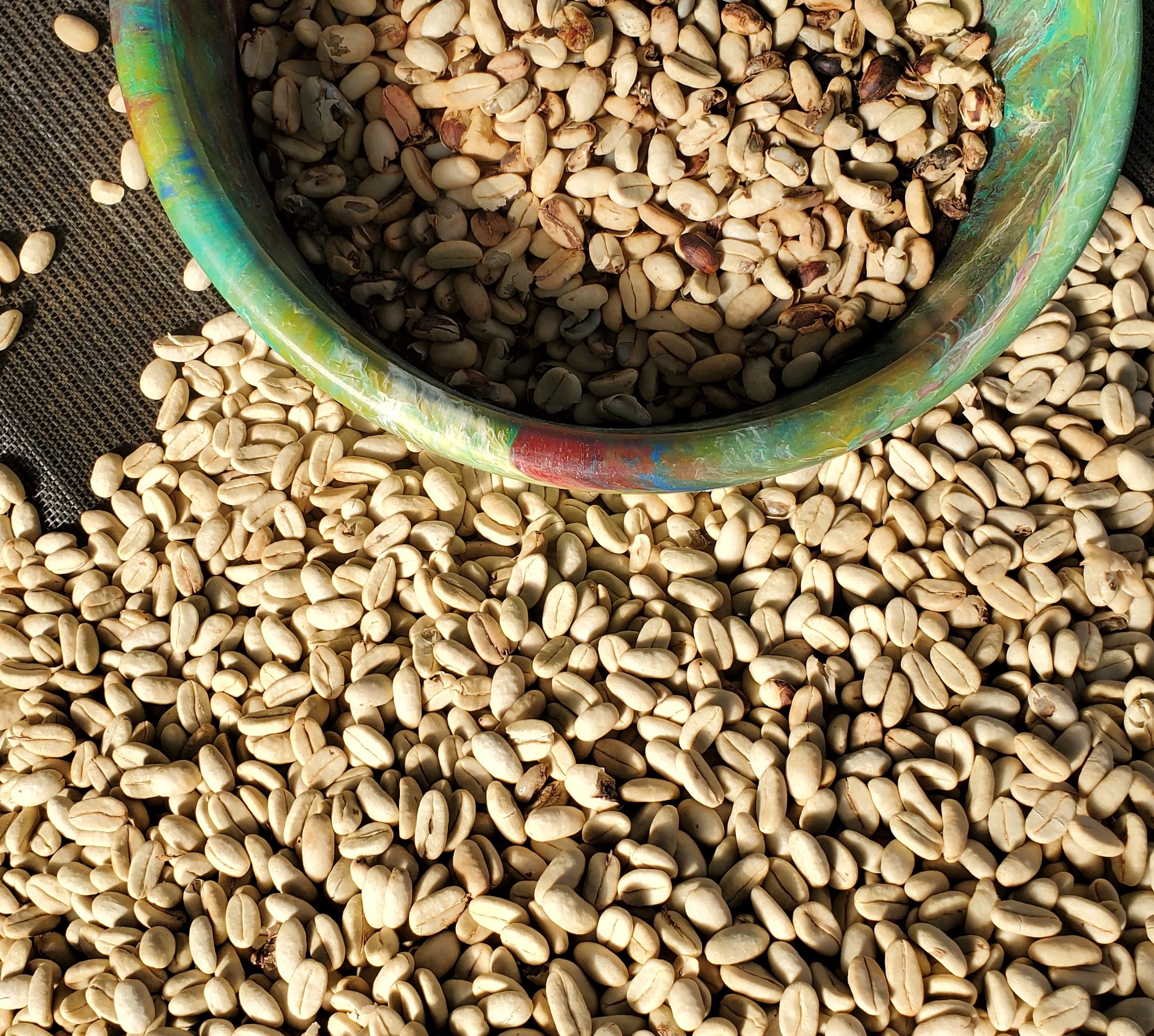
Screen size measures the physical diameter of a green coffee bean. Nothing more. It is expressed as a fraction of an inch, in increments of 1/64th = 0.3969 mm. Screen 18 means the bean is retained on a screen with holes of 18/64th inch (7.14 mm) diameter. Screen 15 means holes of 15/64th inch (5.95 mm).
The measurement system is defined internationally by ISO 4150 — the standard for size analysis of green coffee by manual or mechanical sieving.[1] A stack of screens is arranged from largest aperture at the top to smallest at the bottom. Green coffee is passed through. Each bean falls until it is caught by a screen it cannot pass through. That screen's number becomes its size classification.
ISO 4150 specifies eleven round-aperture screens (from 2.80 mm to 8.00 mm) plus a separate set of seven slotted screens for peaberry classification. The tolerances for ISO 4150-compliant screens are significantly tighter than standard test sieves — because the step from one screen to the next can be as small as 0.25 mm, and overlap between adjacent screens would produce meaningless results.[1]
In North and South America, the historical system uses 64th-inch round screens — the same series used for cereals and other agricultural goods. In East Africa, screens are also rounded but the resulting lot designations use letter grades (AA, AB, C, PB). The underlying measurement is the same. The naming is not.
Screen size is a physical measurement of bean diameter. It is not a quality score. It is not a flavour indicator. It is a uniformity and logistics tool — and one of the most important inputs for planning a consistent roast.
There is no universal grading system. Every producing country has its own. The same physical bean size will be called something different depending on where it was grown. This causes confusion at the commercial level and occasionally creates annoying pricing dynamics, where a label implies quality the underlying measurement does not guarantee.
Here is how the major naming systems map onto actual screen sizes:
The EAS 130:1999 standard (East African Community) classifies flat beans using round-hole screens and peaberries using slotted screens — consistent with ISO 4150. Under EAS 130, Kenya AA is beans retained on screen 18 (after passing through screen 21); AB is beans passing through screen 18 retained on screen 16. When a grade is specified, a minimum 95% of beans must fall within that grade category.[2]
Papua New Guinea uses a letter-grade system (A, B, Y, Y2, Y3 for Arabica; R1, R2 for Robusta), with screen size reported as a suffix. An "A-18" lot means Grade A quality with beans sorted to screen size 18.[3] The screen size number is the same. The grading framework around it is different.
This is the part that matters most. Screen size does not tell you anything about cup quality directly. The correlation between larger beans and better flavour is real in some origins, at some altitudes — and genuinely unreliable everywhere else.
The SCA Green Arabica Classification System (GACCS) requires that specialty-grade coffees (Grade 1) have no more than 5 secondary defects in 300g, zero primary defects, and a maximum of 5% of beans falling outside the stated screen size. Screen size is listed as a uniformity requirement — not a quality threshold.[4] The quality lives in the cup. Screen size facilitates the path to a consistent cup.
Beans of different sizes absorb heat at different rates. A larger bean has greater mass and more surface area. It absorbs energy differently than a small bean sitting in the same drum, at the same charge temperature, on the same curve. If you roast screen 19/20 beans mixed with screen 14/15 beans in the same batch, the smaller beans will overdevelop before the larger ones reach first crack. The result is an uneven roast across the batch — not because of any roasting error, but because the inputs were inconsistent from the start.
Research on the physical changes of coffee beans during roasting confirms that bean dimensions — length, width, and thickness — expand significantly during roasting (Arabica: +19–21% in length from green to light roast), and that these dimensional changes behave differently depending on starting bean size and shape. Arabica beans tend to elongate during roasting; Robusta tends to widen. This matters for how heat distributes across the bean surface and how quickly the interior reaches the temperatures required for Maillard reactions and first crack.[5]
Familia Salazar — Los Cipreses, Naranjo, Costa Rica (1,600–1,650 masl) Cristian and Greivan's lots at Los Cipreses separate by variety at the screen level — SL28, Gesha, and Caturra are processed and dried separately, then screened independently before consolidation into export lots. The result is that each variety arrives with its own tight size distribution. A Gesha and a Caturra from the same farm will roast differently regardless of origin — separating them by screen before they ship means a roaster can treat each as what it is: a distinct lot with distinct heat behaviour.
Bean size is shaped by genetics, altitude, water availability, and processing method.
Variety is the most consistent determinant of size. SL28 and SL34 tend toward larger bean size. Gesha is variable — sometimes large, sometimes surprisingly small. Ethiopian heirloom landraces are characteristically small — screen 14 or even below — regardless of altitude. Maragogype and Pacamara are genetically predisposed to produce very large beans, sometimes 30–40% larger than standard Arabica. Parainema, the variety Rene Fernandez grows at Las Huellas in Honduras, produces a bean that sits firmly in the medium-large range at his altitude of 1,380–1,450 masl.
Higher altitude means cooler temperatures, which means slower cherry maturation. Slower maturation generally correlates with longer cell development inside the seed — producing denser, and often somewhat larger, beans. But this relationship is not consistent across species or varieties. High-altitude Ethiopian coffees routinely disprove it. The altitude-to-size relationship is a useful heuristic, not a rule.
The rapid growth phase of the coffee cherry — roughly two to five months after flowering — is where water availability has the most direct impact on seed size. Adequate rainfall during this phase supports fuller bean development. Water stress during this window can produce smaller, sometimes wrinkled beans with uneven screen distribution. Soil nutrient availability follows similar logic: cherries at the end of branches, furthest from the trunk, receive nutrients last and produce smaller beans — which is also where peaberries are most frequently found.
Processing has a secondary effect on screen size through its influence on drying rate and moisture distribution. Rapid, uneven drying can cause internal stress fractures and dimensional changes that affect how a bean behaves on a screen. Controlled drying — uniform airflow, appropriate temperature, stable rest periods — preserves bean geometry and produces more consistent size distribution within a lot.
Ratnagiri Estate — Karnataka, India (Ashok Patre, 1,000–1,500 masl) At Ratnagiri, varieties Cauvery, Catuai, Chandragiri, SLN9, and Kent are processed and dried in separate streams. Ventilated greenhouse drying, combined with stainless steel fermentation infrastructure, gives Ashok fine control over the drying curve per variety. The result is tighter within-lot screen consistency than most multi-variety estates achieve. When we run PSS checks on Ratnagiri lots, the screen distribution routinely hits 95%+ within the declared range — which is not accidental.
Peaberry deserves its own section. It is the most commonly misunderstood size category in the entire grading system. A peaberry forms when only one of the two seeds inside a coffee cherry develops. The single seed has no flat face (the result of two seeds pressing against each other during development) and grows into a rounded, oval shape. It is classified using slotted screens rather than round-hole screens — ISO 4150 specifies seven oblong-aperture screens specifically for peaberry classification.[1]
Peaberry beans are smaller in diameter than the flat beans from the same harvest. By the logic that larger = better, they should be inferior. They are not. Peaberries are frequently among the highest-scoring lots in a given harvest, and they are usually priced at a premium — sometimes above AA from the same farm.
The reason is partly concentration (one bean receiving all the nutrients meant for two), partly shape (the round form allows more even heat distribution in the roasting drum), and partly selectivity (peaberry lots by definition require an additional sorting step, which removes other defects in the process).
In Kenya, where screen-size grading is most rigidly applied to pricing, peaberry lots increasingly outscore AA at the cupping table even while selling for the same or higher prices. The logic of "bigger is better" breaks down completely when you look at a peaberry honestly.
Under the SCA grading framework, screen size sits within a broader quality assessment structure. For Specialty Grade (Grade 1), the requirements relevant to screen size are:
Screen uniformity is a prerequisite for quality assessment, not quality itself. A lot that fails the screen uniformity check at Grade 1 is automatically downgraded — not because it tastes worse, but because its roasting behaviour becomes unpredictable. Uniformity is the input. Quality is what emerges from a controlled roast applied to a well-prepared input.
Screen size changes how you build a roast profile. Or a blend. Not dramatically. But measurably.
The interaction between screen size and density compounds this. A large-screen, high-density lot (a washed Kenyan AA at 1,800 masl, for example) behaves very differently from a large-screen, low-density lot (a low-altitude natural with high moisture content). Screen size alone does not dictate roasting strategy. It is one input among several. But it is an input that changes the baseline.
Research on arabica and robusta roasting confirms this: arabica beans tend to elongate during roasting while robusta beans tend to widen, and these dimensional changes are significant enough to affect how heat distributes through the bean surface during the drying and Maillard phases.[5] A roast profile developed for one species or size range may not translate directly to another without adjustment.
01
Own screens. Use them. A set of graduated sieves (screens 14, 15, 16, 17, 18) costs very little and gives you direct verification of any lot you receive. Pass 100–300g through your screen set. Check what percentage falls within the stated range. The SCA standard is 95%. If you're consistently below that on arrival samples, talk to your importer.
02
Never mix screen sizes in the same roast batch. Mixing screen 19/20 with screen 15/16 in a single batch will produce uneven development regardless of roasting skill. The smaller beans will overdevelop before the larger beans are ready. If you receive a lot with wide screen distribution, separate it before roasting.
03
Build separate profiles for meaningfully different sizes. A 2-screen gap (e.g., screen 15 vs. screen 17) is significant enough to warrant a different profile. Adjust charge temperature, drying phase length, and development time accordingly. Start conservative and adjust based on Rate of Rise and first crack timing.
04
Don't pay a premium for a label — verify the underlying screen. AA, Supremo, Superior — these are size designations, not quality guarantees. Ask your importer for the actual screen distribution data. "Kenya AA" is only meaningful if you know the screen number, the density, and the defect count alongside it.
05
Treat peaberry as a separate lot — always. Peaberry beans are round. They roll differently in the drum. They heat more evenly because of their shape. Never blend peaberry with flat beans in the same roast. Give them their own profile. You will usually be rewarded with a cleaner, more even cup than you expected.
06
Read screen size alongside density and moisture — never alone. A screen 18 bean at 0.67 g/mL freely settled density and 12% moisture behaves very differently from a screen 18 bean at 0.72 g/mL and 10.5% moisture. The number on the screen is the start of the physical description. Not the whole of it.
07
Don't dismiss small-screen lots on size alone. Ethiopian G1 coffees. Yirgacheffe. Sidama. Screen 14, sometimes screen 13. Some of the most complex, most demanded coffees in specialty. Small beans. Extraordinary cups. Cup the lot. Let the score tell you what size cannot.