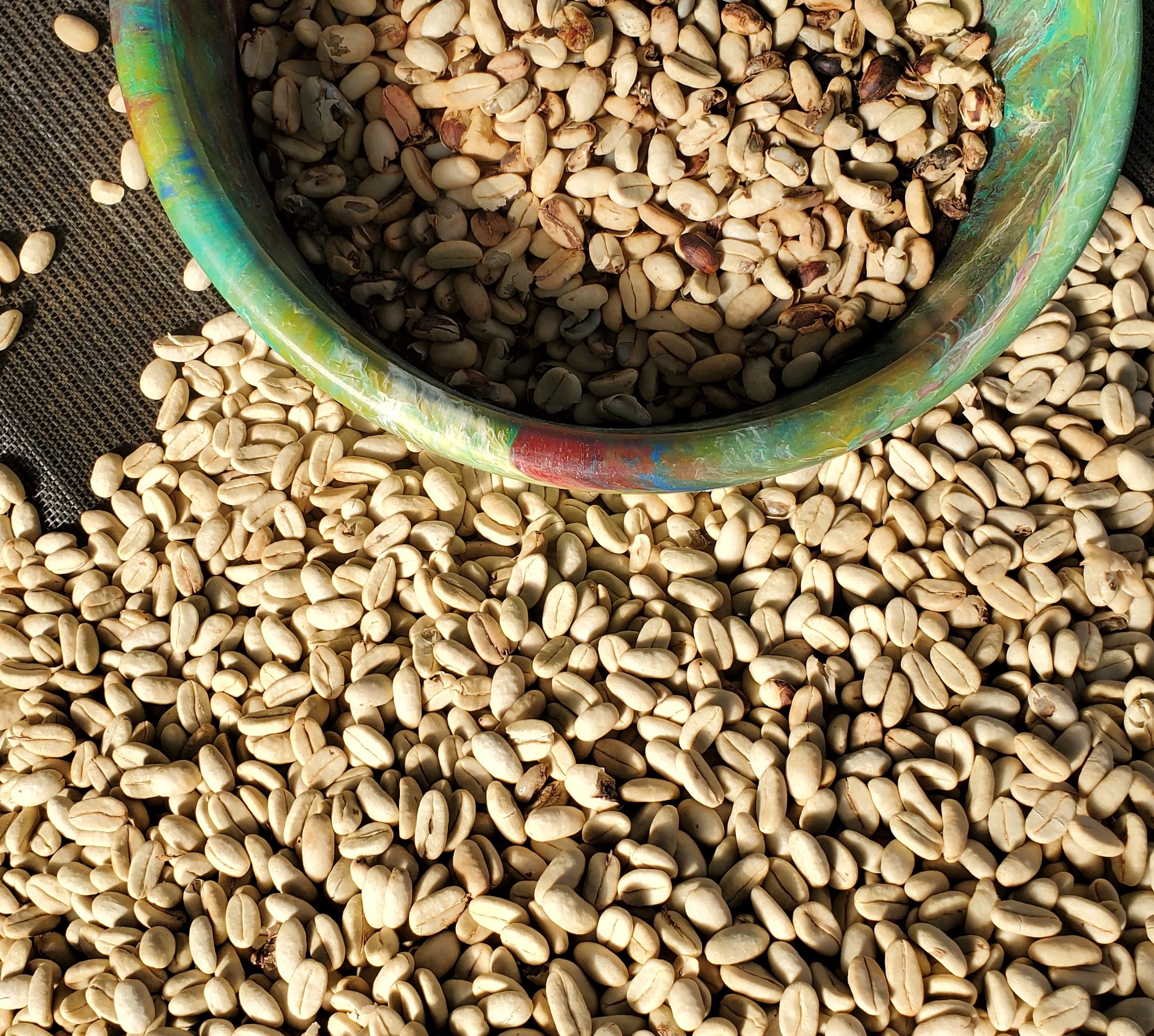
Every black bean, every sour bean, every pale quaker that survives into a roast is the end of a chain of decisions. A cherry picked unripe. A fermentation left too long. A drying bed loaded too deep. A mill calibrated too aggressively. A bag stored against a warm wall. The defect did not appear at the warehouse. It was made — at a specific stage, by a specific cause — and it carried that history all the way to the roaster.
A defect count is the most honest record a green coffee carries. It tells you how the cherry was picked, how the lot was fermented, how it was dried, how it was milled, how it was stored. Read it properly and it becomes a map of the work — and of where the work fell short. The industry has two formal languages for that map. Neither is perfect. Both are useful. This article explains what they measure, what the science actually says a defective bean is, and how we read defects at change of tone. — not as a pass-fail gate, but as a conversation with the people who grew the coffee.
A defect is any bean, or any piece of non-bean material, that does not belong in a clean, exportable lot. That covers two very different things. The first is intrinsic defects — the beans themselves: black, sour, immature, insect-damaged, mouldy, broken, faded, shells, floaters. These are coffee that went wrong. The second is extrinsic, or foreign, matter — sticks, stones, husk fragments, parchment, dried cherry pods, and, in the worst cases, glass, metal, or plastic. This is material that should never have entered the lot at all.
Both categories matter, but they matter for different reasons. Intrinsic defects are mostly a cup-quality and consistency problem. Foreign matter is mostly a food-safety and equipment problem — a stone in a roaster drum is expensive in a way a quaker is not. The reason defects are graded at all is that a small number of bad beans can damage a large volume of good coffee. A single full black bean carries enough off-flavour to taint a cup. A handful of immature beans flattens sweetness across an entire batch. Defect grading exists because the few can spoil the many — and because the cost of the few should be visible, named, and priced, not quietly absorbed at origin.
There are two that matter, and they were built for different audiences. The SCA Green Arabica Coffee Classification System — historically the SCAA system, and the one most specialty importers and Q graders use — is built for quality assessment. It sorts defects into two categories by severity and converts a physical count into a grade. It is a quality language.
ISO 10470:2004 — Green coffee — Defect reference chart — is built for trade. Prepared by ISO Technical Committee 34, Subcommittee 15, it lists the main categories of defect found in green coffee worldwide, across species, variety, and processing — wet-processed Arabica, dry-processed Arabica, dry-processed Robusta. Its purpose is contractual: it assigns each defect a coefficient for loss of mass and a coefficient for sensorial concern, so that buyers and sellers can specify defect terms inside a purchase contract or for a stock exchange. It is a commercial language. The distinction is worth holding onto. The SCA system answers is this specialty? ISO 10470 answers what is this worth, and what does the contract require? A serious importer should be fluent in both — because a coffee is graded for quality but bought under contract.
A note on the SCA system in 2026. The widely-cited 2004 grading protocol — "zero category 1 defects, no more than five full category 2 defects in 350 g" — has been formally superseded by the SCA's Coffee Value Assessment (CVA) framework. The defect categories and the physical grading method remain in active use and remain the reference most of the trade still works to. We cite the 2004 thresholds here because they are still the operational benchmark in most contracts. Expect the language to keep evolving.
Primary, or Category 1, defects are the severe ones. The SCA treats them as disqualifying: a single Category 1 defect in a 350 g sample is enough to remove a coffee from specialty grade. They are graded on a strict 350 g sample — roughly 2,000 to 2,500 beans — sorted under full-spectrum light against a matte black surface, because the dark background reveals pale defects that yellow interior light hides.
Three of the six primary defects — black, sour, dried cherry — trace back to fermentation and processing control. One traces to drying and storage. One to dry-mill cleaning. One to the field. Primary defects are not random. They cluster around the stages where coffee is most exposed, and they tell you exactly where a process lost discipline.
Secondary, or Category 2, defects are less severe individually — but they accumulate, and the SCA grading system is built to make that accumulation count.
A specialty coffee is rarely lost to a single dramatic defect. It is lost to ten broken beans here, eight immature beans there, a scatter of partial sours — each one minor, all of them together pushing the lot past its threshold. The full-defect equivalent is the mechanism that turns that scatter into a single, comparable number.
One bean, one defect. If a single bean carries two defects — say it is both broken and partially black — the SCA method records only the more severe one. The bean is not penalised twice. Partial black is counted; the broken edge is ignored. This keeps the score honest and prevents double-charging a producer for one piece of damage.
The SCA system does not treat every defective bean as equal. It uses a weighting: one Category 1 defect bean equals one full defect. Category 2 defects require several beans to reach the same weight — three partial blacks, or five broken beans, or ten slightly insect-damaged beans, each equal one full defect.
You count every defect bean in the 350 g sample, convert each type to its full-defect equivalent, and sum them. That single number maps directly to a grade:
You can see in that graph, how many beans of each type it takes to move a lot from one grade to the next. The arithmetic is simple. The implication is not. A grade is a count, and a count is a record of the work. A Specialty-grade defect score is not luck. It is the visible result of careful picking, controlled fermentation, even drying, and a well-calibrated mill — every stage holding its discipline.
Ratnagiri Estate — Karnataka, India (Ashok Patre). With full vertical integration — nursery to dry mill — Ratnagiri now performs defect, screen-size, and density sorting in-house, before export. That matters for a defect count. When sorting happens on the farm that grew the coffee, the reject stream is not discarded as a loss; it is read as feedback. A high immature count points back to picking. A high broken count points back to mill calibration. The defect score becomes a tool for next harvest, not just a verdict on this one.
A defect is not only a visual category. It is a measurable change in the bean. The clearest body of work here is the research of Franca, Oliveira, Mendonça and colleagues, who compared the physical and chemical attributes of black, sour, and immature beans against non-defective beans — and the earlier study by Mazzafera. The findings are consistent, and they explain why defective beans behave the way they do in a roaster and a cup.
Three things are worth pulling out of that research.
First — non-defective beans are heavier and denser. Black and immature beans carry less mass, lower density, less sucrose, less oil. This is the physical basis for density sorting and flotation: defective beans genuinely weigh less, so water and gravity tables can separate a meaningful share of them.
Second — black and sour beans roast to a lesser degree than sound beans under the same conditions. They do not take colour the way healthy beans do. In a mixed batch this means the roaster is, in effect, applying one profile to two different coffees at once — and the defect beans will always be under-developed relative to the rest.
Third — immature beans never formed their sugar reserves. This is the chemistry behind the quaker, and it deserves its own section.
A quaker is an immature bean that has been roasted. It is the most deceptive defect in green coffee, because in the green state it can pass inspection — and only reveals itself once the coffee leaves the roaster. The chemistry is simple. Browning during roasting depends on the Maillard reaction and on caramelisation — both of which require sugars, principally sucrose, and amino acids. An immature bean was harvested before the cherry finished ripening, so it never accumulated those sugar reserves. Without sugar, it physically cannot brown. While the sound beans around it turn a deep mahogany, the quaker stays a pale, peanut-skin tan.
In the green state, an immature bean can sometimes be spotted — a yellowish, opaque tone, a tightly adhering silverskin, a "boat-shaped" inward curve along the flat side. But often it blends in. This is the frustrating gap at the heart of the defect: not every green bean graded "immature" becomes a quaker, and not every quaker is obviously immature in the green. The defect is only fully confirmed after a sample roast.
Two further points from the research. Not all quakers come from immaturity — insect or microbial attack can also strip a bean's sugars, producing what graders call "stinky" or defective quakers, distinct from the milder "tame" quakers of simple immaturity. And the cup impact is real but threshold-dependent: a single quaker can introduce inconsistency between cups, while studies indicate that four or more immature beans in a cup produce a statistically significant drop in score, driving astringency and a loss of sweetness. The practical conclusion is the one we hold to: a quaker count cannot be taken from green grading alone. It requires a light sample roast. Any roaster buying on a defect spec should ask whether the immature figure was confirmed post-roast — and any honest offer should say.
The fix is at the tree. Quakers are removed most effectively before they ever exist — by picking only ripe, fully coloured cherry. Flotation tanks before pulping and density sorting after drying will catch a share of underripe beans, and optical sorting will catch more. But every layer of downstream sorting is damage control. Selective picking is the only stage where the defect is genuinely prevented rather than chased.
Most defects are a flavour problem. Mould is also a safety problem, and it is the one defect category where the stakes go beyond the cup. The mycotoxin that matters in coffee is Ochratoxin A (OTA) — a nephrotoxic compound, classified as a possible carcinogen, and regulated with maximum limits in the European Union and elsewhere. It is produced by certain moulds when they are allowed to grow on the bean.
The conditions that allow that growth are well documented: fungi develop quickly once temperature rises above roughly 20 °C and relative humidity climbs above about 65 %. Those conditions can occur during a slow or interrupted drying, in a humid warehouse, or inside a sealed container crossing the equator. This is the direct link between mould and the two metrics we measure on every lot — moisture content and water activity. A coffee dried and held within range is a coffee that does not give mould the water it needs. Two points of perspective. Roasting destroys a large majority of any OTA present — on the order of 96 % — and specialty grading flags any visible mould as a defect, so the well-prepared specialty supply chain carries genuinely low risk. The wellness-internet claim that most coffee is dangerously contaminated is not supported by accredited testing. But the correct conclusion is not complacency. It is process. Mould is almost always a failure of drying or storage, not an inevitability of nature — which means it is preventable, and preventing it is squarely the job of everyone in the chain.
Rene Fernandez — Las Huellas, Santa Barbara, Honduras. The second drying facility we co-sponsored at Las Huellas in 2018 was built around exactly this problem. A rail system with a movable trolley, parabolic dryers designed for airflow, raised beds — all of it serves one purpose: a controlled, even drying curve that brings the coffee down to a stable moisture and water activity without the slow, damp windows where fungus takes hold. Drying infrastructure is not a luxury. It is defect prevention, built in steel and shade cloth.
If there is one idea to carry out of this article, it is this: defects are not distributed randomly across a lot. Each type clusters around a specific stage of production, and reading a defect profile backwards tells you where a process needs attention.
When a sorter or a hand-grader pulls defects from a lot, what comes out is a diagnosis. A reject stream heavy in immature beans is a conversation about picking. One heavy in broken beans is a conversation about the mill. One heavy in sour and black is a conversation about fermentation and drying. The defect count closes one harvest. The defect profile opens the next one. This is why we treat the reject stream as evidence, not waste.
01
Grade a real sample, properly. Use a 350 g representative sample. Sort under full-spectrum light (around 4000–5000 K) against a matte black surface. The black background reveals pale defects — quakers, parchment, floaters — that warm interior lighting hides.
02
Separate Category 1 first. Find and count every primary defect — full black, full sour, dried cherry, fungus, foreign matter, severe insect damage. A single one disqualifies a coffee from specialty. Once you have found one, you already know the grade outcome.
03
Convert before you conclude. Do not count raw beans — convert. Three partial blacks, five broken beans, ten slight-insect beans each equal one full defect. The total full-defect equivalent is the number that maps to a grade. Ten broken beans is two full defects, not ten.
04
Confirm quakers with a sample roast. Green grading alone undercounts quakers. Roast a light sample and count the pale beans that emerge. If an offer quotes an immature figure, ask whether it was confirmed post-roast.
05
Smell the green. Before sorting, smell the sample. Musty, fermented, chemical, or mouldy odours in green coffee rarely improve through roasting. An off-odour is a reason to slow down, not to proceed.
06
Measure moisture and water activity beside the defect count. A defect score, a moisture reading, and a water-activity figure together describe a lot's physical condition. Any one alone tells you much less. For lots stored beyond three months, water activity is the early warning.
07
Read the defect profile, not just the score. A failing grade is the end of the story. The type of defect is the start of the next one. Heavy immature points to picking; heavy broken points to milling; heavy sour and black point to fermentation and drying. Tell your importer what you saw.
08
Grade arrival samples against the offer. A coffee sold as carefully prepared should arrive carefully prepared. Compare the arrival sample's defect count to the offer and pre-shipment samples. If preparation was paid for, it should be visible on the bench.